
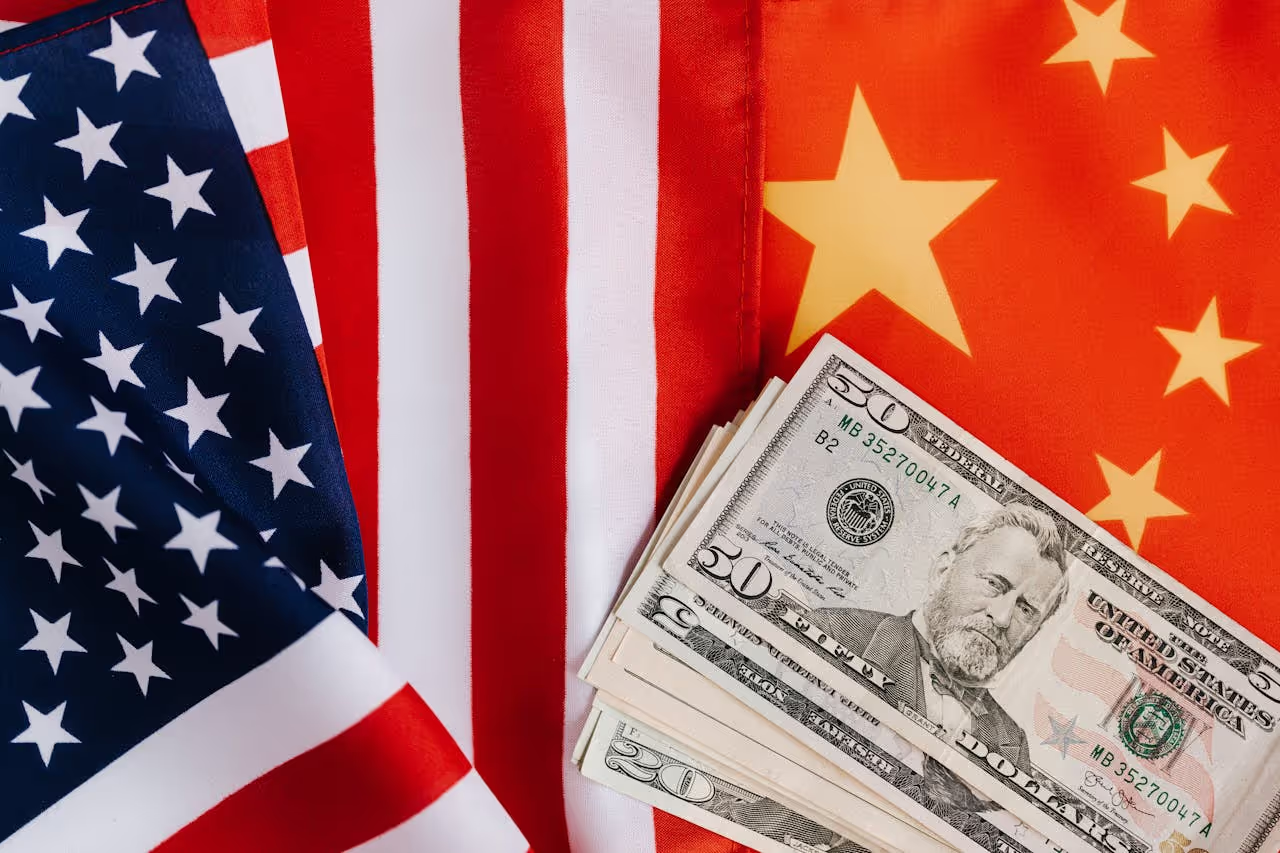
A Tale of Two Systems: The US vs. China and the Perils of Asymmetric Capitalism
Divergent Paths of Industrialization and Globalization
The latter half of the 20th century was largely defined by the economic dominance of the United States. Emerging from World War II as the world’s preeminent industrial power, the U.S. championed a global economic order built on the principles of open markets, free trade, and a commitment to a rule-based international system, embodied in institutions like the General Agreement on Tariffs and Trade (GATT) and its successor, the World Trade Organization (WTO). This framework, known as the Washington Consensus, promoted deregulation, privatization, and trade liberalization as the universal path to prosperity. For decades, this model appeared to be an unmitigated success, fostering global economic growth and solidifying the U.S.’s position as the world’s sole superpower.
However, the dawn of the 21st century witnessed the dramatic rise of a new economic powerhouse, one that played by a different set of rules. China’s economic miracle was not built on the foundations of the Washington Consensus, but on a unique model of state-directed capitalism. While embracing market mechanisms to a degree, the Chinese Communist Party (CCP) has maintained a firm grip on the commanding heights of the economy. Through a vast network of state-owned enterprises (SOEs), a strategic industrial policy that utilizes massive subsidies, and a tightly controlled financial system, the CCP has been able to direct the flow of capital towards its strategic priorities. This has been coupled with a managed labour market, which has suppressed wage growth and limited the rights of workers, and a mercantilist trade strategy that has prioritized exports and the accumulation of foreign exchange reserves. This model, sometimes referred to as the Beijing Consensus, has presented a powerful challenge to the Western-led economic order, attracting a flood of foreign investment and transforming China into the “workshop of the world.”
This great divergence between the economic models of the U.S. and China has had profound consequences for the global allocation of capital. In its agnostic pursuit of efficiency and profit, capital has flowed from the high-wage, highly regulated economies of the West to the low-wage, loosely regulated economy of China. This has led to a massive deindustrialization of the American heartland, as companies have shuttered factories and moved production offshore to take advantage of lower labour costs. While this has resulted in lower prices for consumers, it has come at a tremendous social cost, hollowing out communities, depressing wages, and exacerbating economic inequality.
To truly grasp the magnitude of this shift, we must delve deeper into the historical context. The post-WWII era, often referred to as the “Golden Age of Capitalism,” was characterized by a social contract in the West that balanced the interests of capital and labour. Strong unions, a rising minimum wage, and a progressive tax system ensured that the benefits of economic growth were broadly shared. This led to the emergence of a large and prosperous middle class, which in turn fuelled a virtuous cycle of consumption and investment. However, beginning in the 1970s and accelerating in the 1980s and 1990s, this social contract began to unravel. The rise of neoliberal ideology, with its emphasis on deregulation, privatization, and free trade, led to a series of policy changes that tilted the balance of power decisively in favour of capital. The decline of unions, the erosion of the minimum wage, and the globalization of production all contributed to a stagnation of wages for the majority of American workers, even as the economy as a whole continued to grow.
It was into this environment that China emerged as a major player on the global economic stage. Following the death of Mao Zedong in 1976, Deng Xiaoping initiated a series of far-reaching economic reforms that opened up the country to foreign investment and market forces. However, unlike the “shock therapy” approach adopted by many former Soviet bloc countries, China’s transition to a market economy was a gradual and carefully managed process. The CCP retained control over key sectors of the economy, such as banking, energy, and telecommunications, and used its control over the financial system to direct capital towards its strategic priorities. The establishment of Special Economic Zones (SEZs) in coastal areas provided a laboratory for market-based reforms and a gateway for foreign investment. The success of this model was cemented by China’s entry into the WTO in 2001, which gave it unprecedented access to global markets and further accelerated its integration into the global economy.
The decision to admit China to the WTO was based on the belief that economic liberalization would inevitably lead to political liberalization. It was assumed that as China became more integrated into the global economy, it would be forced to adopt Western norms of transparency, rule of law, and democratic governance. This assumption, however, has proven to be profoundly mistaken. Instead of changing China, globalization has been changed by China. The CCP has demonstrated that it is possible to have a dynamic, market-based economy without a corresponding relaxation of political control. In fact, it has used the fruits of economic growth to strengthen its grip on power, investing in a vast surveillance state and a sophisticated propaganda apparatus to quell dissent and maintain social stability.
The Human Cost: A 30-Year Wage Comparison
The human consequences of this global capital shift are most starkly illustrated in the divergent wage trends of American and Chinese workers over the past three decades. While the U.S. economy has continued to grow in aggregate terms, the benefits of that growth have flowed disproportionately to the owners of capital and a small sliver of high-skilled workers. For the vast majority of the American workforce, real wages have stagnated or even declined.
A 2015 report by the Economic Policy Institute (EPI) paints a grim picture of this wage stagnation. As the table below shows, from 1979 to 2013, the hourly wage of a typical middle-wage worker in the U.S. grew by a mere 6%, while the wages of low-wage workers actually fell by 5%. In stark contrast, the wages of the highest earners soared, with the top 1% seeing their annual wages grow by a staggering 138%. This dramatic decoupling of wages from productivity growth—which increased by 74% over the same period—is a direct consequence of the erosion of worker bargaining power and the relentless pressure to cut labor costs in the face of global competition [1].
| US Wage Growth (1979-2013) | Growth Rate |
|---|---|
| Low-Wage Workers | -5% |
| Middle-Wage Workers | +6% |
| High-Wage Workers | +41% |
| Top 1% of Earners | +138% |
| Productivity | +74% |
Source: Economic Policy Institute [1]
In China, the story has been one of explosive wage growth, albeit from a very low base. As the country has integrated into the global economy, the demand for labour has skyrocketed, pulling hundreds of millions of people out of rural poverty and into urban manufacturing jobs. While reliable, long-term data is harder to come by, available statistics show a dramatic increase in urban wages. For example, one study found that the real weekly wage for urban workers more than tripled between 2008 and 2023 [2]. By 2024, the average annual wage for urban employees had reached 124,110 yuan (approximately $17,000 USD), a figure that would have been unimaginable just a few decades ago [3].
| China Urban Wage Growth | 2008 | 2023 |
|---|---|---|
| Real Weekly Wage (CNY) | 461 | 1,423 |
Source: IZA World of Labor [2]
However, this rapid wage growth has been accompanied by significant challenges. The benefits have been unevenly distributed, with a growing gap between urban and rural incomes. The hukou household registration system has created a class of migrant workers who lack access to social services and are vulnerable to exploitation. And the focus on rapid, export-led growth has come at a tremendous environmental cost, with widespread air and water pollution and the degradation of natural ecosystems.
Both countries had a labour segment suffer the consequences of its system, in the US, the market decided, and in China the Politburo decided. It is a distinction that does not matter to the person suffering the consequences.
The social consequences of these divergent wage trends have been profound. In the United States, the stagnation of middle-class incomes has led to rising levels of debt, declining social mobility, and a growing sense of despair. The opioid crisis, which has ravaged many former industrial communities, has been linked to the economic dislocation and loss of hope caused by deindustrialization. In China, the massive internal migration from the countryside to the cities has created a host of social problems, including overcrowded housing, strained public services, and the breakdown of traditional family structures. The environmental degradation caused by rapid industrialization has also led to a rise in public health problems and social unrest.
Global Implications and Systemic Risk
The asymmetric nature of the U.S.-China economic relationship has created a host of global challenges and systemic risks. The concentration of manufacturing in China has made global supply chains increasingly vulnerable to disruption, a fact that was starkly illustrated by the COVID-19 pandemic. The initial outbreak in Wuhan led to a shutdown of Chinese factories, causing a ripple effect across the global economy as companies struggled to source essential components and finished goods. This has led to a growing recognition of the need to build more resilient and diversified supply chains, even if it means sacrificing some of the cost efficiencies of the old model.
Furthermore, the economic friction between the two countries has fuelled a rise in geopolitical tensions. The U.S. has accused China of unfair trade practices, intellectual property theft, and currency manipulation, leading to a series of trade disputes and the imposition of tariffs. This has, in turn, created a nationalist backlash in both countries, making it more difficult to find common ground on pressing global issues like climate change and nuclear proliferation. The concept of “weaponized interdependence” has entered the geopolitical lexicon, as both the U.S. and China have shown a willingness to use their economic leverage for strategic ends. The U.S. has used its control over the global financial system to impose sanctions on its adversaries, while China has used its control over key supply chains to put pressure on its trading partners.
Perhaps most insidiously, the perceived unfairness of the global economic system has led to an erosion of public trust in democratic institutions and the principles of free-market capitalism. In the United States and across the Western world, a growing number of people feel that the system is rigged against them, that the benefits of globalization have flowed to a small elite while they have been left behind. This has created a fertile ground for populist movements on both the left and the right, which have capitalized on this sense of economic anxiety and cultural displacement to challenge the established political order. The Brexit vote in the United Kingdom, the election of Donald Trump in the United States, and the rise of far-right parties in Europe are all manifestations of this populist backlash against the perceived failures of the neoliberal order.
This erosion of trust has created a vicious cycle. As citizens lose faith in the ability of democratic governments to manage the economy and protect their interests, they become more susceptible to the appeals of demagogues and authoritarians who promise simple solutions to complex problems. This, in turn, can lead to the adoption of protectionist and nationalist policies that further undermine the global economic order and exacerbate geopolitical tensions. The result is a world that is more fragmented, more conflict-prone, and less able to address the collective challenges that we face, from climate change to pandemics to nuclear proliferation.
The Hollowing Out of the American Middle Class: A Deeper Look
The narrative of the hollowing out of the American middle class is not just a story of economic statistics; it is a story of profound social and cultural transformation. The decline of manufacturing, once the bedrock of middle-class prosperity, has had a devastating impact on communities across the country. The closure of a factory is not just the loss of jobs; it is the loss of a way of life. It is the erosion of a social fabric that was woven around the shared experience of work, community, and a sense of collective identity.
The psychological impact of this deindustrialization cannot be overstated. For generations of American workers, a factory job was more than just a source of income; it was a source of dignity, pride, and a sense of purpose. It was a ticket to a middle-class life, with a home, a car, and the promise of a better future for one’s children. The loss of these jobs has created a profound sense of betrayal and resentment, a feeling that the American dream is no longer attainable for ordinary people.
This sense of economic insecurity has been compounded by a growing cultural anxiety. The decline of the traditional, male-breadwinner model of the family has challenged long-held notions of masculinity and social order. The rise of a more diverse and multicultural society has created a sense of displacement and unease among some segments of the white working class. And the perceived moral and cultural decay of the nation has sparked a sense of nostalgia for a bygone era, a time when America was seen as a more virtuous and cohesive society.
These economic and cultural anxieties have created a fertile ground for populist movements on both the left and the right. On the left, figures like Bernie Sanders have tapped into a deep well of anger at the excesses of Wall Street and the corporate elite, calling for a political revolution to reclaim the country from the hands of the “billionaire class.” On the right, figures like Donald Trump have channelled the resentments of the white working class, blaming their economic woes on immigrants, foreign competition, and a corrupt political establishment. While their proposed solutions may differ, both of these movements are a response to the same underlying problem: the hollowing out of the American middle class and the erosion of the American dream.
The Geopolitical Chessboard: Weaponized Interdependence
The concept of “weaponized interdependence,” first coined by the political scientists Henry Farrell and Abraham Newman, has become essential for understanding the new era of geopolitical competition between the United States and China. It refers to the ways in which states can exploit the asymmetries of their economic interdependence to gain a strategic advantage over their rivals. In a world of globalized supply chains and interconnected financial markets, the ability to control key nodes in these networks has become a powerful new form of leverage.
The United States has long been a master of weaponized interdependence. Its control over the global financial system, and in particular the dominance of the U.S. dollar, has given it a powerful tool for projecting its power and influence. Through the use of financial sanctions, the U.S. has been able to isolate its adversaries from the global economy, cutting them off from the flow of capital and trade. The sanctions imposed on Iran, for example, have had a devastating impact on its economy, crippling its oil industry and leading to a sharp decline in living standards. The U.S. has also used its control over key technologies, such as semiconductors and software, to put pressure on its rivals. The ban on the sale of U.S. technology to the Chinese telecommunications giant Huawei is a prime example of this strategy.
However, China is rapidly developing its own capacity for weaponized interdependence. Its dominance in manufacturing, particularly in key sectors like telecommunications, renewable energy, and pharmaceuticals, has given it a powerful new form of leverage. The COVID-19 pandemic starkly illustrated this, as countries around the world found themselves dependent on China for essential medical supplies, such as masks, ventilators, and personal protective equipment. China has also been using its control over key raw materials, such as rare earth minerals, to put pressure on its trading partners. In 2010, for example, China cut off the supply of rare earth minerals to Japan in response to a territorial dispute, causing a major disruption to Japan’s high-tech industries.
This new era of weaponized interdependence has created a far more complex and dangerous geopolitical landscape.
The lines between economics and security have become increasingly blurred, as states are now willing to use their economic leverage for strategic ends. This has led to a new era of “geo-economic” competition, in which states are using a variety of tools, from trade and investment to sanctions and cyberattacks, to advance their interests. This has created a more fragmented and conflict-prone world, one in which the risks of miscalculation and escalation are ever-present.
The challenge for policymakers is to find ways to manage this new era of geoeconomic competition without resorting to a new Cold War. This will require a new spirit of international cooperation, a willingness to find common ground on issues of mutual concern, and a commitment to strengthening the rules-based international order. It will also require a new approach to economic statecraft, one that recognizes the importance of building resilient and diversified supply chains, investing in technological innovation, and promoting a more inclusive and equitable model of globalization.
References
[1] Mishel, L., Gould, E., & Bivens, J. (2015). Wage Stagnation in Nine Charts. Economic Policy Institute. https://www.epi.org/publication/charting-wage-stagnation/ [2] Zhang, J. (2018). The Chinese labor market, 2000–2024. IZA World of Labor. https://wol.iza.org/articles/the-chinese-labor-market/long [3] National Bureau of Statistics of China. (2025). Average Annual Wages of Persons Employed in Urban Units in 2024. https://www.stats.gov.cn/english/PressRelease/202505/t20250520_1959885.html