
The Bedrock of Freedom: What Is the Proper Role of Law?
What if the very system designed to protect your life, liberty, and property has been turned into the most effective weapon against them? It’s a provocative, almost unsettling question. Yet, it wasn't posed in a modern think tank or a viral social media post. It was the central thesis of French economist and philosopher Frédéric Bastiat in his seminal 1850 essay, The Law. Though written over 170 years ago, its analysis feels so current it could have been published this morning. In a world of complex regulations, competing special interests, and endless political debate, Bastiat’s work cuts through the noise with stunning clarity. He argues that society has taken the simple, noble concept of law—a collective shield to protect individual rights—and twisted it into a sword used for personal gain and misguided social engineering. This transformation, he warns, has catastrophic consequences for freedom, justice, and social harmony. This article dives into the core arguments of Bastiat's timeless essay. We will explore the law’s one true purpose, uncover the two forces that corrupt it, and examine the dangerous philosophy that justifies this corruption. Finally, we'll return to Bastiat’s powerful, simple solution—a return to freedom.
Before diagnosing the problem, Bastiat establishes a crystal-clear baseline: what is the law supposed to be? His definition is elegant and rooted in a profound understanding of natural rights. He argues that life, liberty, and property are not gifts from government; they are gifts from God that predate all human legislation. Our existence, our freedom to act, and the fruits of our labor are the fundamental components of what makes us human.
Personality (Individuality): This is our very being, our existence as unique individuals.
Liberty: This is our freedom to use our faculties, to think, to work, and to pursue our own happiness without harming others.
Property: This is the extension of our personality—the things we create through our labor and ingenuity.
Since every individual has the inherent right to defend these three pillars of their existence, it logically follows that they can band together to do so collectively. This collective organization of the individual right to self-defense is what Bastiat defines as the law.
Think of it this way: the law is not a social planner, a charity organizer, or a national parent. It is a bodyguard. Its sole legitimate function is to protect the rights that already exist, to ensure that one person cannot violate the life, liberty, or property of another. Its purpose is to substitute a common, organized force for the chaotic individual forces of self-defense. In this view, the law is purely defensive. It is a shield, not a sword.
The Great Perversion: When the Shield Becomes a Sword
Here, Bastiat identifies the tragic turning point where everything goes wrong. Society takes this defensive tool, meant to secure justice for all, and reforges it into an offensive weapon. The law, which should only be used to prevent injustice, becomes the very instrument of it. He calls this phenomenon “legal plunder.”
Legal plunder is the act of using the law's power of coercion to take from one person or group and give to another—something that would be considered a crime if an individual did it without the sanction of law. When this happens, the law loses its moral authority and becomes a source of conflict rather than stability.
The Two Corrupting Forces
How does such a fundamental perversion happen? Bastiat identifies two primary causes, one born of malice and the other, more insidiously, of good intentions.
1. Naked Greed: This is the more straightforward of the two culprits. It’s the simple, age-old desire of people to live and prosper at the expense of others. Individuals and groups realize it is easier to seize wealth through the legislative process than it is to create it through their own labor. By lobbying for protective tariffs, industry subsidies, or favorable regulations that stifle competition, they use the state’s monopoly on force to line their own pockets. It’s a sophisticated form of theft, laundered through the political process.
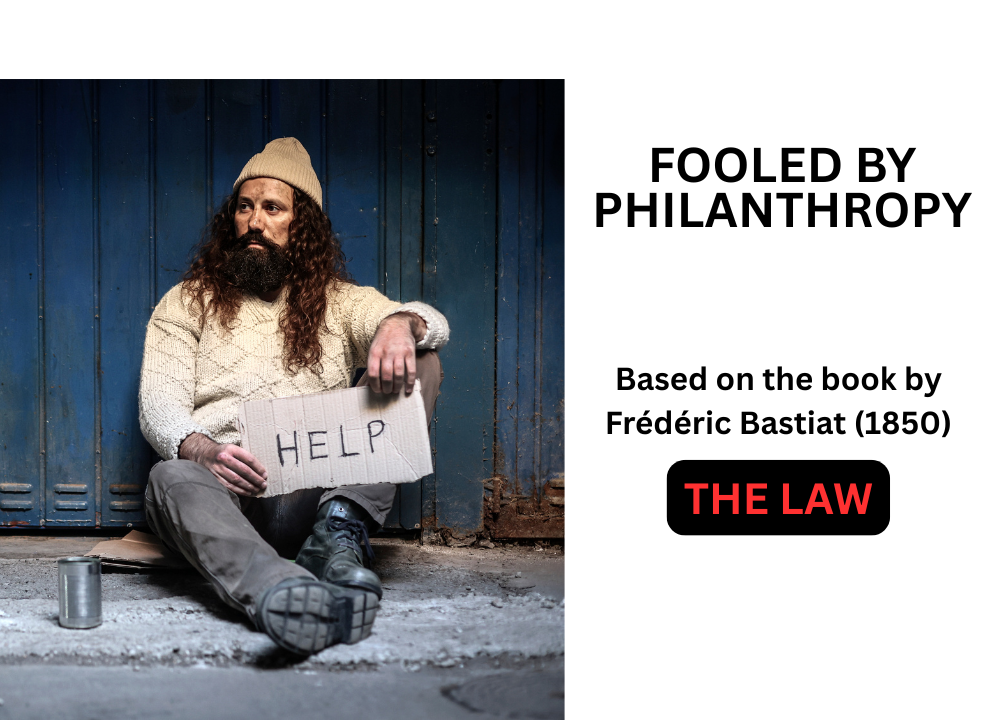
2. Misconceived Philanthropy: This second source is far more subtle and, in Bastiat’s view, far more dangerous. It doesn't stem from a place of malice but from a sincere, albeit misguided, desire to do good. Proponents of this view want to use the law to organize labor, education, and charity—to engineer a better society. They see inequality and suffering and believe the most efficient solution is to empower the state to redistribute wealth and manage human affairs. While the intention may be noble, the method—coercion—is the same as that of naked greed. This is the trap that well-meaning people fall into, believing they can achieve virtuous ends through forceful means.
The Fallacy of Forced Fraternity
Bastiat is particularly critical of this “misconceived philanthropy.” He exposes its central, delusional premise: the idea that you can make a society wealthier by legally taking from everyone to give to everyone. The law, he reminds us, cannot create anything. It has no wealth of its own. It can only transfer what already exists.
When the law is used to enforce charity, it fundamentally destroys the virtue it seeks to promote. True charity, brotherhood, and generosity are, by their very nature, voluntary. The moment you introduce force—the moment you compel someone to give through taxes for a social program—it ceases to be an act of benevolence and becomes an act of coercion. In the process, you violate two fundamental principles:
Liberty is destroyed: The individual is no longer free to choose how to use their own resources or to whom they will show compassion.
Justice is trampled: By taking property from one person without their consent and giving it to another, the law has committed the very act of plunder it was created to prevent.
This creates a catastrophic moral confusion. When the law itself engages in plunder, the line between right and wrong becomes hopelessly blurred. People lose respect for the law because it no longer aligns with a universal sense of justice. Instead, politics devolves into a high-stakes, all-out war. It ceases to be a debate about justice and becomes a frantic scramble to seize control of the lawmaking machinery to benefit one's own group at the expense of all others. This, Bastiat argues, is a surefire recipe for perpetual social conflict and civil unrest.
The Arrogant Philosophy of Control: The Potter and the Clay
What kind of worldview allows this perversion of law to take root and flourish? Bastiat argues it is based on an ancient and deeply arrogant assumption about the relationship between rulers and the ruled. For centuries, he writes, political thinkers have viewed humanity as passive raw material—clay to be molded—and the legislator as the wise and benevolent potter who must shape it into a desirable form.
This mindset presumes that individuals are inert, incapable of making their own choices, and that all progress, virtue, and order must be imposed from the top down by an enlightened elite. Bastiat quotes numerous influential thinkers to prove his point, revealing a shocking consistency in this philosophy.
Jean-Jacques Rousseau, a hero of the French Revolution, saw the lawmaker as a brilliant engineer who must invent the entire social machine, with the people being nothing more than passive components set into motion.
Fénelon, a tutor to French royalty, imagined utopian societies where the prince was responsible for every detail of the people's lives, with their happiness being a gift bestowed upon them, not a product of their own efforts.
The most chilling expression of this idea comes from Louis de Saint-Just, a radical leader during the Reign of Terror, who declared that the legislator's role was to “remake humanity itself.” This is the absolute peak of the potter-and-clay mentality. It is the intellectual engine that drives misconceived philanthropy, justifying any infringement on individual liberty in the name of a supposed greater good designed by a wise planner.
The Radical Solution: Let Freedom Reign
After this devastating diagnosis of the problem, its causes, and its philosophical roots, Bastiat offers a solution that is as powerful as it is simple. He dismisses all the complex, artificial, top-down systems of social organization. The answer, he declares, is not a better plan or a wiser planner. The answer is freedom.
If you simply restore the law to its proper, limited function—to be a shield that protects every individual's life, liberty, and property from plunder—then human energy is unleashed. When people are free to use their talents, to innovate, to trade, and to cooperate voluntarily, they will find their own way to prosperity and a better life. The law’s job is not to direct our energies but to secure the peaceful framework within which we can direct them ourselves.
Conclusion: The Weight of Responsibility
We come full circle, back to Bastiat’s foundational principle: the law is, and should only be, organized justice. Its mission is not positive but negative. It is not to actively *do good,* but to actively *prevent evil.* It is there to stop you from harming me and to stop me from harming you. By performing this one function with unwavering consistency, it provides the space society needs to breathe, to grow, and to flourish organically.
This leaves us with a profound and perhaps uncomfortable question. If the law is not responsible for our industries, our education, or our charity, then who is? Bastiat’s answer is clear: We are.
The responsibility falls squarely on the shoulders of individuals, families, and communities, acting voluntarily in what we now call civil society. It’s a heavier burden than relying on a state to solve our problems, but it is the only path that is compatible with true liberty and lasting justice. Bastiat’s 170-year-old essay challenges us to this day: are we willing to accept the responsibility that comes with freedom, or will we continue to ask the law to be our sword, forgetting that a sword has two edges?