
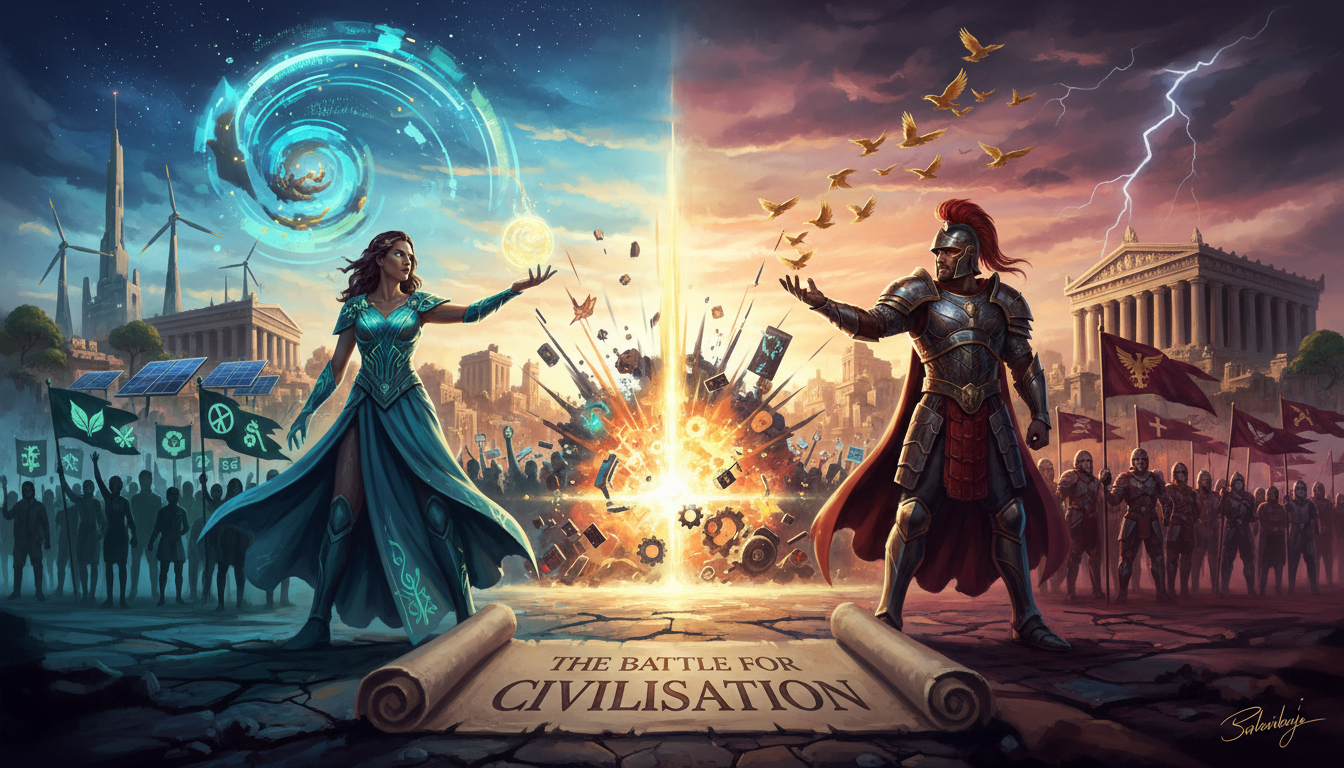
A Personal Political Philosophy
A quick bit of background: I grew as a child of Apartheid in South Africa, with all the concomitant benefits - most notably, good schooling and even University bursary. My family deemed me 'left', but it was more complicated than that.
I thought white people had fairly conquered the land, just like every other nation state. I personally preferred 'white'/ western European society. But, given the demographic composition of the country, I thought 'white rule' was incongruent-the wealth was too unevenly spread for any peaceful co-existence, and that we needed a solution of self-determination. I supported the (short-lived) 'tri-cameral' system where the various ethnographic groups governed their own territories and make their own rules. Ironically, the way South Africa is developing is that one small province (Western Cape) is large run on those principles and is flourishing. The rest of South Africa not so much.
Having said that, when Mandela was released, I decided to emigrate (to Australia). It was clear from the beginning (not just to me, hundreds of thousands of South Africans) that our home country would go the path of all other post-colonial African countries. And it has.
Today, you would classify me as a conservative (on the surface), but I for instance don't support religion in schools (I am a Christian), I support the legalisation of soft drugs, and I am against government funding of Private Schools. These would be 'progressive' ideas. But I am against mass immigration, I am staunchly in support of free speech even it means hate speech and I am anti-censorship. (Ironically in the Hippie era when I grew up, the lefties were fighting for these principles, but something shifted and now these are deemed conservative values.)
If you watch & read below, you will see why I think the way I do. But right now, the World needs a period of stabilisation, assimilation and reset - and as such, a conservative approach to governance.
I. On the Nature of Political Division
Modern democratic politics is organised around a binary: left and right. This division is often moralised, as though one side represents enlightenment and the other regression. I reject this framing. The left–right divide is not a battle between good and evil, but between competing failure modes.
Neither side offers a permanent solution to governance because governance is not a problem that can be solved — only managed. Societies are living systems, not machines. They require adaptation and restraint, expansion and consolidation. When either impulse dominates for too long, the system destabilises.
The healthiest political state, historically and theoretically, is not ideological victory but cyclical correction.
However, this does not mean the left and right are always equally dangerous at all times. Power is asymmetric. Influence concentrates. Institutions drift. Any honest political philosophy must acknowledge not only ideas, but where those ideas accumulate power.
II. Power Is Not Evenly Distributed
While both left and right contain excesses, contemporary Western societies exhibit a clear institutional imbalance.
Progressive ideology disproportionately occupies universities, media, cultural institutions, law, NGOs, and the permanent bureaucratic class. This is not a conspiracy claim; it is a structural observation supported by decades of sociological research. These institutions shape norms, language, incentives, and legitimacy — often independently of electoral outcomes.
This matters because institutional power outlasts electoral power.
A conservative government may win an election, but it governs through progressive institutions. A progressive movement, by contrast, can lose elections and still shape reality through courts, education, regulation, and culture.
Thus, the oscillation between left and right is no longer clean. The pendulum still swings electorally, but the floor itself is tilted.
This asymmetry weakens democratic correction mechanisms and increases the likelihood of social rupture.
III. Framing, Moralisation, and Permanent Crisis
Political conflict today is driven less by policy disagreement and more by moral framing. Issues are increasingly presented not as trade-offs but as existential crises.
A recurring pattern appears in progressive governance:
Identify a natural, emergent, or unavoidable human phenomenon
Reframe it as a systemic moral failure
Declare it unsolvable in principle
Use its permanence to justify endless oversight, regulation, and control
This is not manipulation in the crude sense. It is often sincere. But sincerity does not negate consequence.
Climate, bias, identity, inequality, and even speech itself are framed as perpetual emergencies — conditions that can be managed but never resolved. This produces a politics of permanent intervention and moral dependency.
As Foucault observed, modern power does not rule primarily through force, but through the management of norms. A problem that cannot be solved becomes a licence to govern indefinitely.
IV. Progress and Conservation as Complementary Forces
Progressivism and conservatism are not merely political positions; they are psychological orientations.
Progressives prioritise change, innovation, and moral aspiration. Conservatives prioritise continuity, stability, and social inheritance. Both are necessary. Neither is sufficient.
Nature demonstrates this principle clearly. Growth without consolidation produces fragility. Conservation without growth produces stagnation.
Societies require:
Periods of reform and experimentation
Followed by periods of consolidation, assimilation, and repair
However, political systems are structurally incapable of managing these rhythms well. Election cycles are short. Incentives reward action over restraint. And consolidation policies often appear as inaction, even when they are doing essential work.
Low immigration, for example, looks like “nothing happening,” yet it allows social trust to rebuild, institutions to adapt, and cultural norms to stabilise. Social cohesion is largely invisible until it collapses.
V. The Myth of Benign Central Management
A central flaw in modern governance is the belief that complex social systems can be consciously optimised from above.
History suggests the opposite.
Centralised interventions routinely produce second- and third-order effects that undermine their stated goals. Welfare systems designed to alleviate suffering often weaken family structures and community responsibility. Regulations intended to promote fairness often entrench bureaucracy and stifle innovation.
This does not mean all intervention is illegitimate. It means intervention must be treated as inherently risky, not morally neutral.
The burden of proof should rest on those who wish to interfere, not those who wish to refrain.
VI. The Welfare State and the Problem of Transition
Criticism of the welfare state is often dismissed as cruelty because its immediate beneficiaries are visible, while its long-term costs are diffuse.
It is true that dismantling welfare systems abruptly would cause harm. That reality cannot be ignored. But acknowledging transition costs does not invalidate critique.
The welfare state systematically displaces:
Family obligation
Community support
Religious charity
Personal responsibility
In doing so, it creates dependence while eroding the very social structures required for long-term resilience. This is not hypothetical; it has been documented across generations.
A defensible position is not immediate abolition, but strategic retreat:
Limiting expansion
Reintroducing local and voluntary institutions
Re-aligning incentives toward responsibility rather than entitlement
The question is not whether compassion is necessary, but whether bureaucratic systems are capable of sustaining it without corroding society.
VII. On Minimalism and the Limits of Non-Interference
Advocating minimal government does not require romanticising chaos.
Complete non-interference is neither possible nor desirable. Law, defence, and basic order are non-negotiable. Some regulation is necessary to manage genuine externalities and coordination failures.
However, beyond these core functions, governance should exhibit restraint. Every additional function assumed by the state should be presumed guilty until proven indispensable.
Complex systems self-correct better than central planners. When correction is suppressed, pressure accumulates. Eventually, it releases violently.
VIII. Civilisational Cycles and Human Nature
Civilisations rise not because they eliminate human weakness, but because they constrain it. They fall when systems reward fragility, entitlement, and abstraction over responsibility and reality.
The familiar cycle — strength, prosperity, decadence, collapse — is not moral mythology. It reflects the interaction between human psychology and institutional incentives.
No civilisation escapes this dynamic indefinitely. The best that can be achieved is delay, moderation, and recovery.
IX. Conclusion: A Politics of Limits
My political philosophy rests on a single premise:
Human systems fail not because of too little intention, but because of too much.
The role of governance is not to perfect society, but to prevent catastrophe. Not to moralise endlessly, but to preserve the conditions under which meaning, responsibility, and cooperation can emerge naturally.
Progress must be earned. Stability must be defended. And power — especially well-intentioned power — must be constrained.
That is not pessimism.
It is realism.