
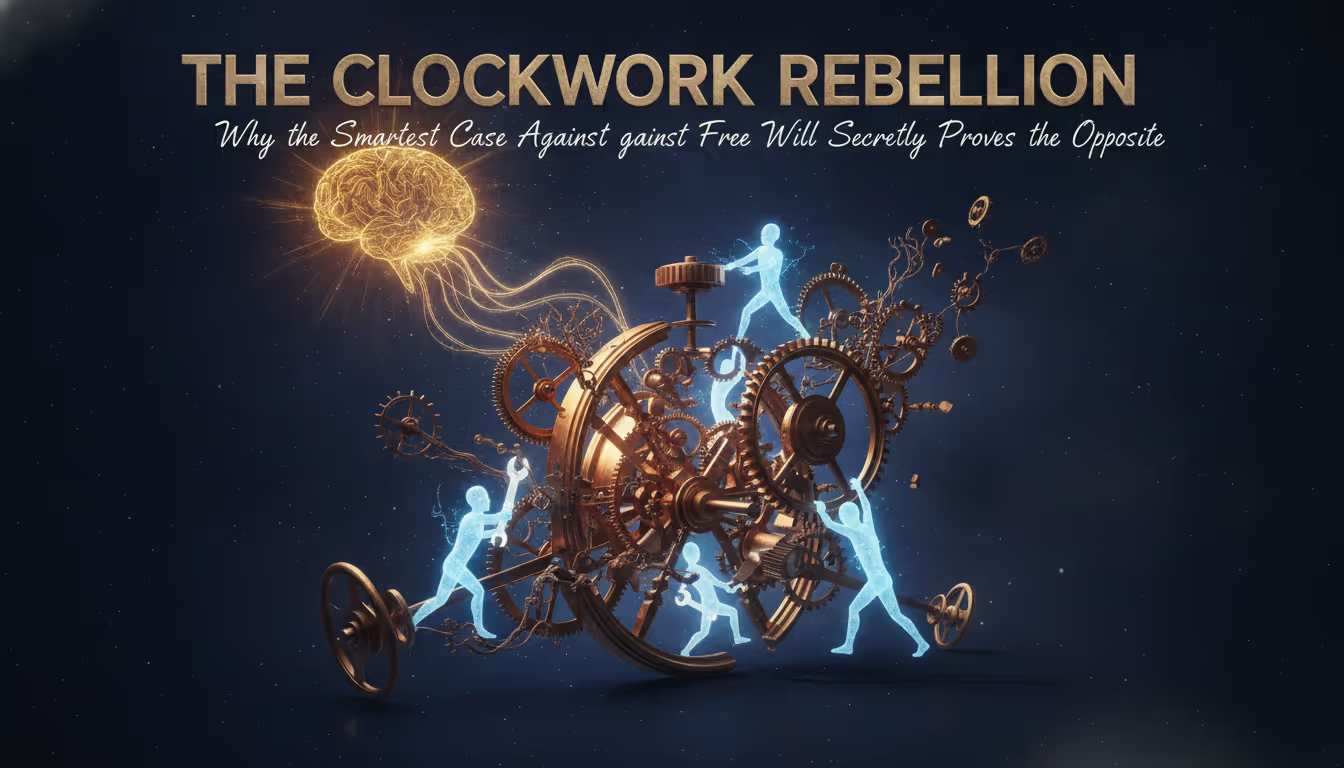
Why the Smartest Case Against Free Will Secretly Proves the Opposite
In the autumn of 1820, Hans Christian Ørsted was giving a lecture at the University of Copenhagen when something peculiar interrupted his demonstration. He was running an electric current through a copper wire, a routine enough procedure, when he noticed that a compass needle sitting nearby had swung off magnetic north. Not dramatically—just a twitch, an almost polite deviation, as if the needle had been startled. Ørsted stopped. He reversed the current. The needle swung back the other way.
There was nothing physically connecting the wire to the compass. No string, no rod, no mechanism of any kind. And yet the needle moved. Not because something had touched it, but because something had changed in the space around it—an invisible structure, a field, that the current had created and the needle had felt.
Ørsted had stumbled onto electromagnetism. But the more interesting discovery—the one that took longer to make and is still being made today—was what it revealed about the nature of causation itself. That something can act on the world without touching it. That fields are real. That the space around a thing, properly configured, is not empty. It is organized. It has structure. It has power.
Two thousand four hundred years before Ørsted's compass twitched, a philosopher named Thales of Miletus held a lodestone in his hand and said something that has been puzzling people ever since. Thales declared that the magnet had a psyche—a soul. He meant it literally and precisely. In his framework, the soul was not a theological entity. It was a functional one: the capacity to initiate motion in the world without being moved first. The magnet, to Thales, possessed this capacity. It could reach across empty space and make things happen. Therefore, in the only sense that mattered to him, it was alive.
For most of the last two and a half millennia, this looked like charming pre-scientific confusion—an ancient Greek anthropomorphizing a rock. But what if Thales was right? Not mystically right, not poetically right, but literally, physically, neurologically right—in ways he had no language to express but that we now do?
That question is where this essay begins. And it leads us somewhere that the current scientific consensus on free will has spectacularly failed to go.
The Delay That Wasn't What You Think
In 1983, a neuroscientist named Benjamin Libet performed an experiment that has haunted the philosophy of mind ever since. He attached electrodes to a group of volunteers, asked them to flex their wrists whenever they felt like it, and told them to note the position of a dot on a clock face at the moment they became aware of the decision to move. The results were unsettling. Libet found that a distinctive pattern of brain activity—what he called the "readiness potential"—appeared in the motor cortex an average of 350 milliseconds before volunteers reported becoming aware of their intention. The brain was preparing to act before the "mind" had decided.
The neuroscientist John-Dylan Haynes took this further with fMRI technology. In a 2008 study at the Max Planck Institute in Berlin, Haynes found he could predict which button a volunteer would press up to ten seconds before they became consciously aware of their choice. Ten seconds. The conscious mind, in this interpretation, is not the decision-maker. It is the press secretary, announcing decisions the machinery has already made, inventing rationales for outputs it didn't cause.
This finding was seized upon by an increasingly confident camp of hard determinists. If the brain's unconscious processes precede and predict conscious choice, they argued, then consciousness is epiphenomenal—a shadow, not a force. Robert Sapolsky, the Stanford behavioral biologist whose 2023 book Determined represents perhaps the most rigorous and readable case for hard determinism yet written, put the position with characteristic directness: by the time you think you're deciding, your neurons have already been decided by their prior states, which were decided by your hormones, your upbringing, your in-utero environment, your genes, and the evolutionary history that shaped all of them. The chain goes back further than you, longer than you, with no gap anywhere for a free agent to slip inside.
It is an argument that wins most dinner table arguments. It is also, I want to suggest, an argument that is measuring the wrong thing—and measuring it at the wrong level.
The Field Is the Mind
Here is something that rarely appears in popular accounts of the Libet experiments: what exactly was being measured.
The readiness potential—and the fMRI patterns in Haynes's study—were detected by tracking the activity of discrete neural populations. Specific regions lighting up. Specific groups of neurons firing. The picture of the brain these techniques produce is like a photograph of a concert hall taken with a camera pointed at individual seats—you can see which audience members are shifting in their chairs, but you cannot hear the music.
Because the music is not in the seats.
In the early 2000s, a molecular biologist at the University of Surrey named Johnjoe McFadden proposed what he called Conscious Electromagnetic Information theory—CEMI theory. The core insight is elegant and, once seen, hard to un-see: the billions of neurons firing in your brain at any given moment are not just generating nerve impulses and chemical signals. They are generating an electromagnetic field—a massive, shifting, unified pattern of electrical activity that extends across the entire brain and slightly beyond it. This field is what EEG machines detect when they press electrodes against the scalp. And McFadden's claim, developed across two decades of subsequent refinement, is that this field is not a byproduct of consciousness. It is consciousness.
Individual neurons, in this view, are the musicians. The electrochemical signals they exchange are the notes. But conscious experience—the unified, integrated, felt quality of being aware—is the music that only exists when all the instruments are playing together. You cannot find the music by examining a single violin. You cannot find consciousness by examining a single neuron, or even a single cortical column. The thing you're looking for exists at the level of the integrated field.
Now here is the move that changes everything. McFadden's field is not passive. It does not simply record what the neurons are doing and float above them, observing. It feeds back. The electromagnetic field that consciousness generates loops back into the neurons themselves—biasing their firing thresholds, modulating their activity, nudging the probability distributions of which neurons will fire next. This is what physicists call downward causation: a higher-order pattern exerting causal influence on the lower-order components that generate it. The field shapes the neurons that generate the field that shapes the neurons.
Return now to Libet's ten-second delay. What he was seeing—what Haynes was seeing—was the early preparation of neural populations. The orchestra tuning up. The readiness potential is not the decision. It is the pre-decisional warming of the neural substrate from which the decision will emerge as a field-level event. The conscious decision, in CEMI terms, is the moment the integrated electromagnetic field resolves—when the full symphony finds its chord—and this moment is not after the neural preparation. It is produced by it, just as the music is produced by the orchestra, while being something qualitatively different from any of the individual instruments.
The delay doesn't show that consciousness is a passenger. It shows that generating consciousness takes time—which is what we would expect, given that consciousness is an emergent property of the most complex physical system we have ever found.
To be clear: CEMI theory is a hypothesis, not a settled fact. It is contested, as all frontier theories in neuroscience are. But it is the most productive framework we currently have for thinking about how the brain's physical activity gives rise to a unified conscious experience—and how that experience is not merely produced by the brain but genuinely acts on it. Dismissing it would be like dismissing the germ theory of disease because the microscopes of the 1850s weren't powerful enough to settle every question.
The Smashed Magnet
On the afternoon of September 13, 1848, a twenty-five-year-old railway foreman named Phineas Gage was tamping blasting powder into a rock face near Cavendish, Vermont, when the charge detonated prematurely. An iron rod—three feet seven inches long, one and a quarter inches in diameter, weighing thirteen and a quarter pounds—entered beneath his left cheekbone, passed behind his left eye, traversed the front of his skull, and exited through the top of his head. It landed, according to witness accounts, some eighty feet away.
Gage was blown backwards. Within seconds, he was speaking. He climbed into the cart that carried him to the boarding house where he would spend his recovery. His physician, John Harlow, initially found him in good enough condition to be sitting upright in his chair.
The physical survival was extraordinary. The psychological aftermath was the detail that passed into the literature of neuroscience. The Gage who recovered was not, by any account that survives, the Gage who had walked onto that worksite. He had been, before the accident, a man of exceptional reliability—responsible, respected by his crew, notable for the balance between his intellectual capacity and his emotional steadiness. The Gage who emerged was volatile, profane, inconsistent, and incapable of sustaining plans that conflicted with his impulses. His friends and family, in the phrase that has been quoted so often it has almost lost its force, said he was "no longer Gage."
Sapolsky cites this case, and dozens like it, to build his argument that the self is nothing more than the configuration of the brain. Alter the hardware, alter the person. There is no "Phineas Gage" that exists apart from the specific arrangement of neurons and their specific patterns of connectivity. The iron rod didn't damage Gage's soul—it damaged his frontal lobe, which contained the substrate of the traits we called "Phineas Gage." There was never anything more to him than that substrate. There never is, for any of us.
This argument is compelling. It is also, if you look at it with the right physics in mind, incomplete in a crucial way.
A permanent magnet—the everyday kind—is magnetic because of something that happens at the level of atomic structure. Each iron atom has what physicists call a magnetic moment, a tiny dipole field generated by the quantum-mechanical property of electron spin. In most materials, these moments point in random directions and cancel each other out. In a permanent magnet, something has caused these moments to align—to all point in roughly the same direction—so that their individual fields add together rather than cancelling, producing one unified, powerful, external field.
Now take that magnet and expose it to extreme heat, or drop it sharply on a hard surface, or smash it with a hammer. The iron atoms are all still there. Every single magnetic moment still exists. What you have done is disorder the alignment—given the domains enough energy to break from their ordered configuration and scatter into randomness again. The field collapses. The macroscopic magnetic behavior disappears. The magnet is no longer a magnet.
But crucially: nothing essential has been lost. It has been disordered. And a disordered magnet can be re-magnetized. You stroke it repeatedly in one direction with a strong external magnet, or you place it in a powerful electromagnetic field, and the domains begin to align again. Slowly, persistently, the atomic moments find their shared direction. The field re-emerges.
What the iron rod did to Phineas Gage was exactly this. It did not destroy his values, his memories, his language, or his cognitive capacities—those remained largely intact, as the historical record shows. What it disrupted was the prefrontal integration that coordinates all these domains into a coherent, unified intentional field. His cognitive "domains"—emotion, planning, memory, social awareness, impulse regulation—lost their alignment. They ceased to point in the same direction. The powerful field that had been "Phineas Gage, foreman" collapsed into something more scattered and reactive.
The determinist reads this as proof that the self is the substrate. But the story doesn't end with a smashed magnet. Because what distinguishes a brain from a bar of iron is precisely the capacity the brain has to realign its own domains. This is the neuroscience of neuroplasticity—the well-established finding that the physical structure of the brain changes in response to repeated patterns of activation. Therapy works, not by talking about feelings, but by establishing new patterns of neural activation that physically rewire the substrate. Meditation works by training attentional circuits. Deliberate practice of any kind works by strengthening the neural pathways that subserve it. And the intentional override of an impulse—the moment you stop yourself from reacting, take a breath, and choose differently—is not just a decision. It is a physical event that slightly re-magnetizes the system.
The Gage case doesn't prove we have no agency. It proves that agency is a structural property—one that can be damaged by trauma, and rebuilt by the hard, unglamorous, daily practice of aligning the self.
The Canvas and the Painter
There is a class of determinist argument that operates at an altitude above neuroscience, in the cleaner air of physics and mathematics. It goes like this: the universe obeys laws. Physical laws are mathematical. Every event, including every neural event that constitutes a thought, follows from prior events according to equations that have no exceptions. There is no place in these equations for a free agent—no gap in the causal fabric where an uncaused cause could insert itself. We are not merely biological, we are physical, and physics closes all the doors.
Physicist Max Tegmark has pushed this to its logical limit with what he calls the Mathematical Universe Hypothesis: the universe does not merely obey mathematics, it is mathematics. The physical world is a mathematical structure, and everything within it—including us—is a pattern within that structure. Under this view, the idea of free will is not just empirically unsupported; it is conceptually incoherent. Mathematical structures don't have free agents. They have states.
The video game analogy makes this feel viscerally true. A sophisticated game engine renders only what the player's camera can see—a technique called occlusion culling—conserving processing power by simply not bothering to compute the reality of things that aren't being observed. Several thinkers have wondered aloud whether the universe works similarly: a procedural simulation rendering just enough reality to maintain consistency, with the rest implied rather than computed. If we're in a simulation, we are, in the most literal sense, code. And code does not choose.
I want to suggest that this argument—for all its vertiginous persuasiveness—makes a category error that is easier to see if you think about chess.
Consider a chess engine. It operates by assigning numerical values to board positions, searching the decision tree to whatever depth its processing allows, and selecting the move that maximizes its advantage score. It is doing mathematics, very fast and very well. Now consider a chess grandmaster. Her neurons obey the same physics as everyone else's. The physical processes in her brain are constrained by the same equations. But she is not operating on the mathematics. She is operating on meaning. When she sacrifices her queen to create a positional bind that will yield advantage in fourteen moves, she is not calculating the probability distribution of game outcomes. She is reading the story of the position—recognizing patterns, intuiting danger, feeling the shape of what a board wants to become—and responding to that semantic reality.
Maxwell's equations govern electromagnetic fields. Quantum mechanics governs probability distributions at the subatomic scale. But these laws describe the substrate, not the pattern. They specify the canvas, not the painting. And here is the critical point: the painting is not determined by the canvas. It is constrained by it—you cannot paint with physical impossibilities—but constraint is not determination. The space of possible paintings on any given canvas is not one.
When you make a choice based on an abstract value—when you act from justice, or loyalty, or love—you are not reacting to a raw physical force. You are responding to a semantic structure that exists at a level of organization higher than basic physics, in the same way that the meaning of a sentence exists at a higher level than the chemistry of the ink. The ink obeys chemistry. The meaning obeys something else: a system of reference, context, and relationship that is causally real even though you cannot find it with a mass spectrometer.
The universe gives us the canvas. The integrated field of a conscious mind makes choices about what gets painted. Those choices are physical events, yes. But they are physical events of a kind—emergent, self-referential, value-laden—that no reductive account of physics predicts or explains.
The Wetness of Choice
There is no wetness in a water molecule. This is not metaphor. It is chemistry. A single H₂O molecule has no capacity to be wet. Wetness—the phenomenon, the sensation, the property—only exists when billions of molecules interact with each other and with a surface. It is what philosophers call an emergent property: irreducible to its components, but absolutely real.
Temperature is emergent—it is the mean kinetic energy of a statistical ensemble of particles, invisible at the level of a single atom. Flocking behavior in starlings is emergent—no individual bird has a "flock algorithm," but the murmuration wheeling across an autumn sky is one of the most structured phenomena in nature. Life itself is emergent—no individual atom is alive, but the right configuration of atoms, interacting at sufficient complexity, produces something that replicates, metabolizes, and responds.
The decisive point about emergent properties—and the one that the hard determinist consistently underestimates—is that they have genuine causal power. Wetness causes things to slip. Temperature causes metals to expand. Life causes organisms to seek resources. You cannot reduce these causes away by pointing to the molecules. The molecules are the mechanism; the emergent property is the cause at its own level of description.
Free will, in the framework I'm proposing, is emergent in exactly this sense. It is not located in any single neuron. It is not located in any single chemical. It is the property that arises when the right configuration of neural activity produces a unified electromagnetic field with sufficient complexity, self-reference, and downward causal power. Just as you cannot find wetness by examining a water molecule under a microscope, you cannot refute free will by showing that individual neurons are deterministic. The relevant level of description is the field—the emergent, integrated whole.
Antonio Damasio spent years studying a patient he called Elliot. Elliot had undergone surgery to remove a small tumour from his prefrontal cortex, and by conventional neurological measures the operation was a success. His IQ was unmoved. His memory was intact. His language was fluent. His perceptual faculties were unimpaired. But Elliot could not make decisions. Asked to choose where to have lunch, he would deliberate for an hour—canvassing the merits of different restaurants, weighing distance against menu against ambience against prior experience—without being able to settle. Simple choices that a neurologically intact person resolves in seconds became for Elliot an endless loop of computation that reached no conclusion.
Damasio's diagnosis was subtle and important: Elliot had lost the ability to feel. The surgery had severed the functional connections between his reasoning circuits and his emotional brain. Without the emotional signal—the somatic marker, in Damasio's terminology, that flags some options as mattering more than others—deliberation had no resolution mechanism. It was pure calculation with no way to stop calculating.
The determinist reads this case as evidence that "choice" is just an emotional tipping point—that we deliberate until one option's affective charge exceeds a threshold and the organism outputs a behavior, like a slow computer waiting for a circuit to trip. But this reading misses what is most interesting about Elliot. He wasn't failing because he had too much rational calculation and not enough emotion. He was failing because his integrated field was incomplete. The emotional circuits are not an irrational override of rational deliberation—they are a crucial input into the unified field that makes evaluation possible. Without them, the system cannot query its own values. It can compare costs and benefits all day without knowing what anything is worth.
Real deliberation—the kind that healthy human beings do when facing genuine choices—is not calculation. It is evaluation. A calculator computes an answer. Deliberation evaluates options against a standard that is itself being refined in the process of deliberation. What standard? The values encoded in the electromagnetic field of a unified, self-referential mind. When you deliberate seriously about a difficult choice, you are not waiting for an emotional threshold to trip. You are actively querying the integrated system you have built—through years of experience, practice, reflection, and prior choice—asking what it actually is, what it actually values, who it actually wants to be.
No passive algorithm does this. Algorithms don't ask who they are. Only agents do.
The Feedback That Rewrites Itself
There is a philosophically sophisticated objection that survives all of the above, and it deserves an honest answer.
Grant CEMI theory. Grant downward causation. Grant emergence. The field still operates according to physical laws. Downward causation is still causation. If the field is shaped by prior field states, and those states were shaped by prior ones, stretching back through your entire life—and through the history of the species that produced your biology—then where does genuine freedom enter? You are still a system operating within a causal chain you didn't initiate and cannot stand outside of.
This objection is correct in everything it asserts. And it misses the most important thing.
There is a class of systems in nature—and the brain is the pre-eminent example—that complexity theorists call self-modifying recursive systems. These are not systems that merely respond to inputs. They are systems that use inputs to change the way they will process future inputs. The output of the system today becomes part of the substrate that generates tomorrow's output. In computer science, this is meta-learning. In neuroscience, it is neuroplasticity. In philosophy of action, it goes by the name self-constitution—the process by which an agent shapes the agent it will be.
When you override an impulse—when you stop yourself from the easy cruelty, from the small lie, from the comfortable avoidance—you are not just making a decision. You are physically rebuilding your brain. The neural pathways that mediate restraint become, through use, more robust. The pathways that mediate the impulse become, through disuse, less dominant. The electromagnetic field you generate tomorrow will be different from the one you generate today, because today's decision changed the substrate that generates it. You are, in a literal and not metaphorical sense, an author writing the software you will run on.
The causal chain here is not linear. It is recursive. The prior states that determine the current decision are themselves partly products of previous decisions. The direction you're heading is not fixed by where you started, because the process of moving has altered the traveler. This is not free will in the sense of a first cause—an uncaused beginning outside the causal order—and no serious philosopher has defended that version for a century. The question is not whether your choices have causes. Of course they do. The question is whether you—the integrated, self-modifying electromagnetic field that constitutes your consciousness—are among those causes. And the answer, taken seriously, is yes.
You are not a cue ball. You are more like a river: shaped by the landscape, certainly, but also continuously reshaping it, carving new channels, creating new possibilities that did not exist before the water arrived.
The Contradiction at the Heart of Determinism
The most honest version of the hard determinist conclusion appears near the end of Sapolsky's Determined. If free will is an illusion, Sapolsky argues, then we cannot meaningfully hold people responsible for their actions. The appropriate response to human behavior—all of it, including the worst of it—is not judgment but understanding. Not retribution but treatment. We should reform our criminal justice system, revise our social institutions, and extend radical compassion to everyone, because everyone is equally the product of forces they did not choose.
It is a genuinely humane conclusion. It is also, examined carefully, a position that cannot be coherently stated.
Here is the problem. If Sapolsky's brain had no choice but to write Determined—if the argument in that book is itself the inevitable output of prior biological and environmental causes—then "we should extend compassion" is not a moral claim. It is a prediction. It is saying: the universe, running its causal program, will produce more compassionate institutions as this idea propagates through the culture. That may well be true. But it cannot be a prescription—a genuine normative "should"—because prescriptions require an audience that could act on them or not. They require beings capable of being moved by reasons, not merely by causes.
The moment a determinist says "we should"—the moment they argue, advocate, appeal, marshal evidence, and invite you to be persuaded—they have implicitly assumed the thing their position denies. They are treating you as a rational agent who can evaluate their argument and choose to be convinced by it. They are borrowing the very freedom they are trying to cancel in order to make the cancellation case.
This is not a cheap rhetorical trick. It is a deep structural problem. The form of the hard determinist argument—the appeal to reason, the marshalling of evidence, the construction of a case designed to change minds—is only coherent if minds can be genuinely changed by reasons, not merely caused to output different behaviors by the stimulus of an argument. The hard determinist, to write the book, must inhabit a self-understanding that the book's conclusion denies.
The position eats itself. Not because the neuroscience is wrong, but because the interpretation of what the neuroscience means is too thin—too committed to the level of neurons and genes and hormones to look up and see what those components make.
The Painter Steps Forward
We began with Thales holding a stone that could move matter without touching it, and asking what kind of thing has the power to do that.
The answer, two and a half millennia later, is still the same answer dressed in more precise vocabulary. The magnet acts at a distance because it has a field—a unified, extended, active structure that imposes its organization on the space around it. The field is not separate from the magnet; it is the expression of the magnet's internal alignment made external, made powerful, made capable of acting on the world. Crucially, the field is not reducible to any single domain. It is what the aligned domains produce, which is something qualitatively and causally different from any one of them.
The human mind is a field of exactly this kind.
Not metaphorically. Physically. The brain generates an electromagnetic field that is the substrate of conscious experience, that feeds back on the neurons that generate it, that can be aligned into coherence through deliberate practice or scattered into reactivity through trauma and disorder, and that—when sufficiently unified and self-referential—achieves something no individual neuron or gene or hormone can achieve alone: the capacity to evaluate itself against its own values and to use that evaluation as a genuine cause of future behavior.
This is what Thales meant by psyche. Not a ghost in a machine. A field in a system. An active, organized, causally efficacious pattern that acts on the world not by touching it but by being structured—by having the internal alignment that makes external action coherent, directed, and genuinely intentional.
The determinists have been so busy demonstrating that the clockwork is real—and it is—that they have missed what the clockwork makes. They are right that the gears turn according to laws. They are wrong that the gears are the story. The story is the coherent, integrated, self-referential pattern that emerges when the right gears turn in the right configuration. And this pattern has a property that no gear possesses: it can look at itself, evaluate what it sees, and use that evaluation to change the way the gears will turn next.
There is a word for a system that does this. The word is agent. And an agent is, by definition, an author—not an uncaused author, but a genuine one. A node in the causal story that takes the incoming narrative and writes its own next page.
So yes: Thales was right.
The magnet has a psyche—not because it contains a ghost, but because it contains something more interesting than a ghost: a unified, active field that acts at a distance, that imposes order on the space around it, and that cannot be found by examining any single atom.
So do you.
The real question—the one that remains when the philosophy settles—is whether your domains are aligned. Do your values, your attention, your daily practice, and your long-term intentions point in the same direction? Do they form a coherent field, unified enough to act on the world with genuine purpose and direction? Or are you scattered—fragmented, contradicted, domains pointing in different directions, a demagnetized bar rattling around in the conviction that the magnet it once was, or could be, was always an illusion?
Because if free will is the capacity of a unified electromagnetic field to be a genuine cause in its own right—to reshape through downward causation the neural substrate that generates it, and through deliberate action the world that surrounds it—then free will is not something you have automatically, by virtue of being conscious.
It is something you build.
Through deliberate attention. Through the repeated alignment of thought and value and action. Through the slow, unglamorous, deeply human work of choosing who to be until the choice becomes the chooser.
The universe provides the canvas.
The unified mind directs the brush.
And the painting, once made, is real—as real as anything physics measures, and far more interesting than anything it predicts.
The CEMI (Conscious Electromagnetic Information) theory discussed here was developed by Johnjoe McFadden of the University of Surrey, principally in his papers "Synchronous Firing and Its Influence on the Brain's Electromagnetic Field" (2002) and the book Quantum Evolution and subsequent work. The neurological case of "Elliot" and the concept of somatic markers are drawn from Antonio Damasio's Descartes' Error (1994). Robert Sapolsky's Determined: A Science of Life Without Free Will (2023) represents the most comprehensive contemporary case for hard determinism and is engaged with directly throughout. Benjamin Libet's original readiness potential experiments were published in Brain (1983); John-Dylan Haynes's fMRI prediction study appeared in Nature Neuroscience (2008). The historical accounts of Phineas Gage derive from John Harlow's original clinical reports and subsequent scholarly reconstruction.


