
Christianity is unique amongst all religions. It is the ONLY religion that does not require works.

The reason I am pessimistic about the 'Jewish' question ever being solved peacefully, is because I believe that they have wandered off the path God wants for them. This article / video explains why Christians believe the OT pointed to the NT.
And they did it on (pretty much) Day 1 of the covenant!To summarise the video :
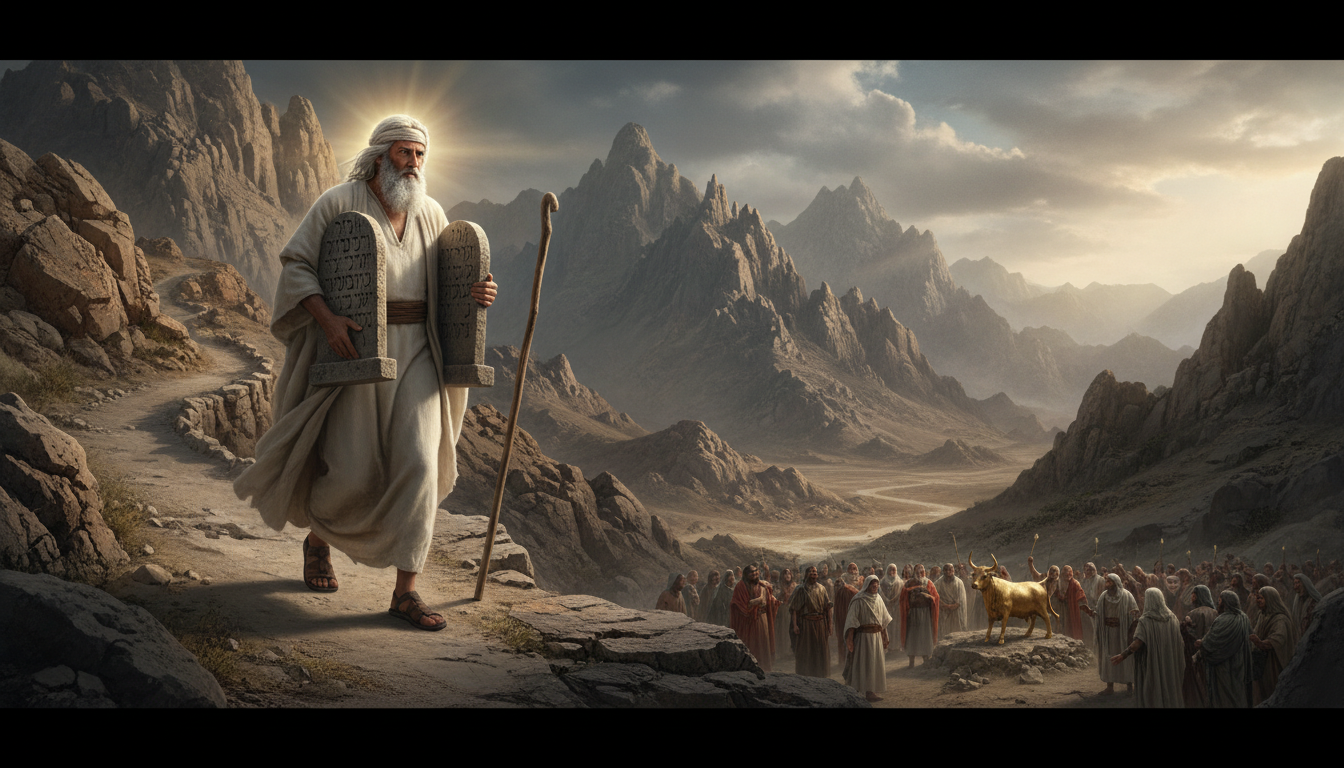
As Moses lingers on the mountain, the people grow restless and fearful. They turn to Aaron, Moses’ brother, and demand that he makes them an idol—a golden calf reminiscent of the Egyptian gods they had left behind. The people worship the calf with feasting and revelry, breaking the very first commandment: “Thou shalt have no other gods before me.”
When Moses descends and witnesses the apostasy, he smashes the tablets of the law, symbolizing the breaking of the covenant. This act is often compared to Adam’s original sin in the Garden of Eden: a foundational rupture that brings lasting consequences. Just as Adam’s disobedience brought sin into the world, Israel’s idolatry fundamentally changes their relationship with God.
The question I leave with you is this:
What is Israel's 'Golden Calf' in these modern times?
Below is the video as well as an AI-generated summary of the explanation by an impressive young guy (Christian B. Wagner) doing some good work. Well worth a listen. I don't agree with everything - he is a Catholic after all - but that doesn't mean you can't learn something.
Introduction: More Than Just a Story About an Idol
For many, the story of the Golden Calf is a familiar one from the Old Testament: while Moses is on the mountain receiving the Ten Commandments, the impatient Israelites build a golden idol to worship. It seems like a straightforward story of idolatry and its consequences. But what if I told you this single event is one of the most pivotal moments in the entire biblical narrative? The incident of the Golden Calf didn't just break a rule; it broke a covenant and fundamentally altered the course of Israel's history, changing the very law they were given.
This event is the key to understanding the complex ceremonial laws of the Old Testament, the criticisms of the prophets, and even the teachings of Jesus and St. Paul. It’s the story of “Israel’s original sin,” and unpacking it reveals a God who meets His people in their weakness, providing a remedy they desperately needed but which was never His original plan.
The Covenant Before the Calf: God's Original Plan
To grasp the magnitude of the Golden Calf incident, we first need to understand what the covenant looked like before it happened. After the dramatic escape from Egypt, marked by the ten plagues and the parting of the Red Sea, Moses leads the people to Mount Sinai. Here, God reveals His plan for them.
In Exodus, chapters 20 through 23, God gives Israel His law. At its core are the Ten Commandments—a beautiful summary of the law of charity. It’s a direct, simple, and profound covenant: “Obey my voice, and I will be your God, and you shall be my people” (Jeremiah 7:23). This original agreement was not burdened by complex rituals, dietary restrictions, or an intricate sacrificial system. It was a covenant based on relationship, trust, and obedience to a moral law written on stone tablets and, ultimately, on their hearts.
This covenant is solemnly ratified in Exodus 24 with a covenant meal, shared by Moses and the elders of Israel. It’s a moment of profound communion, a picture of God dwelling with His people. This was the ideal. This was Plan A.
A Nation's Original Sin: The Breaking of the Covenant
After this ratification, Moses ascends the mountain again to receive further instruction. But while he is away, the people grow restless. They feel abandoned. Turning to Aaron, Moses's brother, they demand a god they can see, a god to lead them. What follows is a catastrophic failure of faith.
They fashion a Golden Calf, likely an idol representing an Egyptian deity, and declare, “These are your gods, O Israel, who brought you up out of the land of Egypt!” (Exodus 32:4). They engage in pagan revelry and immoral acts before this lifeless statue, utterly rejecting the God who had just miraculously saved them.
When Moses descends and witnesses this betrayal, his response is powerfully symbolic. He takes the two stone tablets—the physical representation of the covenant—and smashes them on the ground. This wasn't just a fit of anger; it was a declaration that the covenant had been shattered. Just as Adam's sin broke the original covenant with humanity, the sin of the Golden Calf became Israel's own “original sin,” a collective fall that would have lasting consequences.
A 'Yoke of Bondage': The Law After the Calf
Everything changes after Exodus 32. In the wake of this national apostasy, God institutes a new layer of law. This is where we see the introduction of the intricate ceremonial and sacrificial system detailed in the rest of Exodus, Leviticus, and Numbers. The Tabernacle is built, a formal priesthood is established (with the Levites taking the place of the firstborn sons), and a host of purity laws and burnt offerings are commanded.
But why? These laws weren't a punishment in the punitive sense, but rather a divine accommodation—a remedy for their spiritual sickness. They had demonstrated a deep-seated attraction to the idolatry of their neighbors. Their hearts were weak and prone to wander. So, God gave them a “yoke,” as the Church Fathers would later call it. This ceremonial law was designed to be a strict tutor, a set of guardrails to keep them from veering back into paganism. It was a concession to their weakness, a way to channel their desire for ritual and sacrifice toward the one true God, instead of to idols.
What the Prophets Said: Scripture's Own Commentary
This understanding isn't a modern interpretation; it’s embedded within the Old Testament itself. The prophets repeatedly remind Israel that the rituals and sacrifices were secondary to the true heart of the law.
Jeremiah's Shocking Claim
The prophet Jeremiah makes a statement that can sound scandalous without this context. God says through him: “For in the day that I brought them out of the land of Egypt, I did not speak to your fathers or command them concerning burnt offerings and sacrifices. But this command I gave them: ‘Obey my voice…’” (Jeremiah 7:22-23). Jeremiah is clear: the elaborate sacrificial system was not part of the original Sinai covenant.
Ezekiel's 'Good' vs. 'Not Good' Laws
Ezekiel goes even further, drawing a sharp contrast. He speaks of the original laws as “statutes” and “rules by which, if a person does them, he shall live.” These were the life-giving Ten Commandments. But after Israel rebelled, God says, “Moreover, I gave them statutes that were not good and rules by which they could not have life” (Ezekiel 20:25). The ceremonial laws, while serving a purpose, could not give life in themselves. They were a remedy, not the source of life, which is found in a relationship of love and obedience with God.
A Consistent Theme
This theme echoes throughout Scripture. Samuel tells King Saul, “To obey is better than sacrifice” (1 Samuel 15:22). Hosea proclaims God’s desire: “For I desire steadfast love and not sacrifice, the knowledge of God rather than burnt offerings” (Hosea 6:6). The prophets consistently call the people back to the original covenant of the heart, reminding them not to let the external rituals become a substitute for genuine justice, mercy, and faithfulness.
The Wisdom of the Early Church: How the Fathers Understood the Law
The earliest Christian thinkers and leaders, known as the Church Fathers, universally understood the law through this lens. They saw a clear distinction between the eternal moral law (the Ten Commandments) and the temporary ceremonial law added after the Golden Calf.
St. Justin Martyr: A Concession to Weakness
Writing in the 2nd century, St. Justin Martyr explained that God, “accommodating himself to that nation,” enjoined them to offer sacrifices “in order that you might not serve idols.” It was a divine strategy to prevent a greater evil.
St. Irenaeus: A Yoke for a People Who Desired Servitude
St. Irenaeus argued that when Israel made the calf, they “had gone back in their minds to Egypt,” desiring to be slaves again. So God gave them a form of servitude—the yoke of the ceremonial law—that would bind them to Him rather than to pagan gods.
St. John Chrysostom: The Physician and the Cold Water
St. John Chrysostom offered a brilliant analogy. Imagine a physician with a feverish patient who desperately craves a drink of cold water—something the physician knows is mildly harmful. However, the patient threatens that if he doesn't get it, he will do something far worse, like jump off a cliff. To prevent the greater catastrophe, the physician allows the lesser harm and gives him the cold water.
This, Chrysostom says, is what God did. He saw the Jews “choking with their mad yearning for sacrifices” and on the verge of turning completely to idols. To prevent this spiritual suicide, He permitted them to sacrifice, but directed that worship toward Himself. It was the lesser of two evils, a temporary measure for a sick patient.
Conclusion: Why This Changes Everything
Understanding the Golden Calf as the event that fractured the original covenant is the key that unlocks the entire biblical narrative. It explains why the law became so complex. It clarifies why the prophets railed against empty ritualism. And, most importantly, it illuminates the mission of Jesus Christ.
The Pharisees of Jesus’ day had made a fatal error: they had elevated the secondary, remedial law to the place of primary importance. They meticulously observed the rituals and purity codes—the “cold water”—while neglecting the “weightier matters of the law: justice and mercy and faithfulness” (Matthew 23:23). They had mistaken the medicine for the state of perfect health.
Christ came to fulfill the law—not by adding more rituals, but by healing the heart-sickness that made the rituals necessary in the first place. He abrogated those “secondary bonds” and restored the original covenant of love, writing it not on tablets of stone, but on the hearts of His people through the Holy Spirit. The story of the Golden Calf is not just about a past failure; it’s a profound lesson on the mercy of a God who works through our brokenness to lead us to a freedom and communion far greater than we could ever achieve on our own.