
Every wannabe futurist wants to pick the future before it happens — but the vast majority really only identify trends when the trends are already obvious. The most famous ones are creative about the labels they apply to the next stage of the trend. This is helpful in discussing the trends and creating a common language, but doesn’t add value to how we deal with these emerging realities.
Instead of the above, we will specifically identify the Critical Success Factors of this New Age, (and give it a label) so you know what to concentrate your business efforts on. Most of those won’t be new to you, but you will now know WHY they are so important.
But, we will also introduce one that I am betting you have never considered as a critical success factor for business.
IT’S A NEW AGE
(but it’s not what you think…)
I want to take a slightly larger, macro view of the stages of mankind in order to see where we are, and where we are heading. It is not a prediction of the future, but a description of the reality we find ourselves in — AND what needs to be focused on for us to make this work in our favour. I don’t think anyone can so reliably predict the future that we can be persuaded with foresight. (Hindsight, of course is a wonderful thing.)
A common way of documenting the ‘stages of man’ is illustrated below:
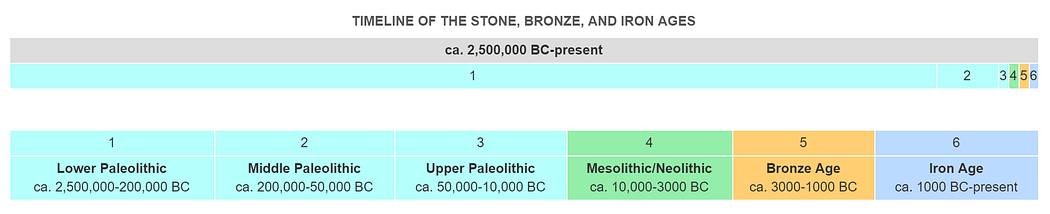
The question is: what is stage 7?
Most people would agree that to describe the present as the ‘Iron Age’ just does not resonate with the era we currently live in. For the last fifty or so years, there has been an increasing ephemeralisation of the world we live in. Products have become services. Analogue has become digital. The world of ‘things’ have become a world of ideas. Mind overcame matter.
So, what IS the age that we live in today?
The ION Age
I posit that the Iron Age came to an end soon after WWII, to be replaced by the ION Age. That was the last major world event where force and influence was forged through the power of physical objects — guns, tanks and bullets.
In prior generations, no matter how far you go back in history, people attempted to control physical resources to ensure survival and prosperity. Nations and identities coalesced around the desire for being nation states. Identities were national and needed a corresponding geography. E.g. Hitler’s ideas still needed the conquest of physical geography to manifest itself. With economic globalisation came individual mobility and the universal or near universal geographic dominance (e.g. the British Empire, The Persian Empire, and the Roman Empire) became impossible.
Ideas travel faster than armies. And people find themselves identifying with certain ideas more than geographies. Somewhere in the decade after WWII (in the 1950s) the power of ideas grew and spawned the idealism of the hippies. This was the first era that had a universal ‘idea’ as its leitmotif when it became heralded as the age of ‘making love not war’. That is, favouring emotion over physical confrontation.
As everything becomes more intangible, it becomes harder to understand. For instance, everybody’s idea of love is different. But love is not the only idea of the ION age, there are many more forces shaping the world that we live in.
Understanding these forces that are prevalent and powerful in the Current Age provides a powerful advantage to those who can harness these forces successfully. But equally important is to clear the common myths and misunderstandings that seem to prevail regarding each of these factors.
Imaginat-ION /Invent-ION /Innovat-ION
Myth: Innovation is about technological advance and imagination is not compatible with scientific endeavour.
More than ever the people who will shape the world are the dreamers. Tim O’Reilly, one of the godfathers of the Internet recently said we are at the beginning of the beginning of the internet. The critical ingredient that will require is that same ingredient that created this world we live in — innovation and invention.
Innovation is a buzz-word amongst the guru-types. But it has become a cliché merely through over-use, which does not invalidate the idea itself. The over-use is for good reason, reflecting the near universal acceptance of the need to innovate and re-invent ourselves and our environment. This need will never abate. On the contrary, it will accelerate.
Educat-ION
Myth: You don’t need an education to be a ‘success’.
The financial successes of College drop-out entrepreneurs and the perverse glorification of not going to college with schemes like those hatched by Peter Thiel has led many to devalue education. They mistake the notion of going to college with getting an education. You can BE and BECOME educated without going to school or college. Being educated is about having insight into how the world works, and being able to convert that insight into proactive participation in the way of the world. It is not the act of acquiring knowledge that may or may not involve a college.
Going to college may be optional, but becoming educated is imperative. Without an education, you will be doomed to merely surviving in this industrial complex that is the world of work. Without education, our innovations will be menial, lacking the scope and the scale that can impact our whole world.
For the world to be ruled by the power of ideas, then those ideas, especially in a complex, advanced and technologically literate society like ours, the people who will be best equipped to create the ideas will be educated people.
I am not suggesting that people with a lesser education cannot contribute or are somehow less than those who have a long list of qualifications; I am merely pointing out that education is imperative, even if the path to that education is non-conformist.
Execut-ION
Myth: Execution is for people who don’t know how to think.
If we use our education for innovation in a way where it remains merely about ideas, then it may as well not exist. Even though we live in a world of ideas, which are inherently intangible, there is of course a clear, practical need for those ideas to often be manifested in our physical world.
Eventually the idea that led to the invention of a pest-resistant crop needs to lead to an actual seed that will actually be planted to grow — or in whatever way we will produce food I the future. The mere idea of an innovation in food must be translated to physical sustenance for it to have value.
Google needs electrical wires and Uber needs cars, and of course a fully functioning website and so forth. Therefore, there is real value in bringing an idea to life through execution. Actually, not just ‘value’ but the compelling, non-negotiable need to execute. Execut-ION is the heart-beat of the ION Age.
Inspirat-ION
Myth: Inspiration is about Creativity.
It’s not. It is about Leadership. One of the biggest challenges facing us in the present, complex times we live in is a paucity of inspiring leaders. Dreamers and ideas are often hi-jacked by demagogues and ideologues and perverted for reasons of power and influence. (Wherever you are on the political spectrum, no one illustrates this better than Trump in the USA.)
We have a dearth of inspirational leaders, people who can lead us towards a place that is for the greater good.
As we turn increasingly inwards to seek solutions in our minds, we also run the risk of becoming more selfish. We can see this by the focus in management literature on the art and science of another ION factor — that of Persuas-ION. Persuasion is the flip-side of inspiration because it is about bending someone else’s mind to your will, whereas inspiration is about offering people the opportunity to exercise their own will, but synchronistically with your vision.
Inspiration lies at the heart of leadership and leadership is what allows large groups of individuals to come together in pursuit of a common goal. Without such inspiration it becomes mere management. And without powerful ideas, inspiration is not possible.
WHAT WE HAVE SO FAR
We now live in the age of innovation, education, inspiration, and execution; an era that is fueled by the power of ideas. The ION Age…
All ideas originate in the minds of people, making us (the people) the most valuable and irreplaceable ‘player’ in this world and we have nothing to fear from Artificial Intelligence or robotics. Innovation is more than technology (which computers can supply). Execution is more than merely doing stuff, which robots can do.
But as important as we are; we are also vulnerable. In a world where ideas are viruses, they spread fast and have massive (possibly fatal) impact. Inspiration, Education, Innovation and the like will help us cope, but it does not guarantee it. There is one critical, missing ingredient.
We don’t have to fear change, but we have everything to fear from those who deny our spirit and our humanity and seek to see the world as mere chaos and people as mere meat puppets dancing to the tune of a genetic symphony.
The other factor we need to acknowledge and leverage in the ION Age is that we must find, cherishand protect our souls.
That may, at first glance, appear to be most un-business- like topic on a ‘business’ blog. But taking a holistic view is important, no, vital to our future success, because I believe that you can separate life into self-contained units of operation and we carry our souls into our cubicles every day, whether we like it or not.
(I expand a bit on this topic — below the conclusion — to argue the case more comprehensively since the topic of spirituality is taboo in most workplaces and needs further discussion for those so inclined.
But I also don’t want to detract from the main point with superfluous content, hence included as a PostScript.
This brings us to the final element we need to master in the ION Age.
Relig-ION
Myth: Atheism and secularism is on the rise, and will make religion redundant because it is an archaic belief system.
I use ‘religion’ as the proxy for ‘spirituality’ because I need it to fit the idea of ION Age.
Current research shows a workforce with ambivalent feelings.
Approximately 30 percent of the participants had positive views of religion and spirituality. A small percentage, roughly 2 percent, had positive views of religion and negative views of spirituality. About 60 percent, or the majority, had positive views of spirituality and negative views of religion; 8 percent had negative views of both religion and spirituality.
That translates to 90% of people being positively disposed towards spirituality. At some point in the future, people will realise that a subjective spirituality is an empty promise, they will return to the time-proven dogmas of a traditional faith. You can only dine on dessert so long before you want to return to the foods that offer actual sustenance.
It is complex, dynamic and fluid. More than ever, foundations, principles and core truths will be needed.
An increased focus on (inner) spirituality, based on sound philosophic principles (and teleological doctrine) is congruent with the ION age and will be a powerful factor in shaping the current age we live in.
SUMMARY
We live in the age of innovation, education, inspiration, execution and religion (spirituality); an era that is fueled by the power of ideas. All the most important stuff are intangible.
The organisations and people who will succeed will do so because they have embraced these elements or features of the ION AGE as critical success factors and mastered them.
All ideas originate in the minds of people, making us the most valuable and irreplaceable player in this world and we have nothing to fear from Artificial Intelligence or robotics.
In a world where nothing lasts, where all the most important things are ephemeral and in a world where we progress is fueled and identities shaped on nothing more than intangible ideas, the one thing that is eternal and lasts forever is increasingly important. People have soul. Forget at your peril.
WELCOME TO THE ION AGE…
WHAT DOES IT ALL MEAN?
It should not be new news that things like innovation, imagination, ideas, education and execution are important. Now you know why they became increasingly important. You also now know that in this ION Age we also need to acknowledge the whole person, including their spirituality if we want to tap into everything people have to offer.
In practice, if you accept that these are all critical success factors, and that teh ION Age is real, what must you understand, know and do differently in your business?
Emotions rule Facts
Rhetoric beats Dialectic
Authenticity is central.
There is nowhere to hide
Consequences happen quickly and are extreme
Adaptability is crucial
Speed is essential
Power is nothing, Influence is everything
I could go on, but you get the idea?
DO THIS: Test your marketing, your brand and your strategy against these (and other you want to add) and see you well you are positioned to prosper in the ION Age.
The purpose of every issue we publish is to make you #thinkdifferent — so the question is, are you?
(If you are strongly anti-theistic, you can stop reading now.)
(PostScript)
Relig-ION (Continued)
I want to spend a bit more time on this topic because the previous topics are covered extensively in management literature. On the other hand, religion/spirituality is rarely raised in the context of business and is worth exploring a bit further. When was the last time you saw something about religion posted on LinkedIn?
I don’t expect to change many people’s minds about this. If I could prove to you logically that your current beliefs about religion (positive or negative) are absolutely false, would you change your mind? You may be tempted to say you would, but let me warn you, I will offer the proof and you won’t change your mind.
But the purpose is not to change your mind, I simply want to point out that this ‘element’ of our humanity is an important factor to consider as we interact with our world, and deserves to be thought about, deeply.
The fact is that spirituality is on the rise. Atheists are coming out of the closet in increasing numbers, but that does not mean there are more atheists than before. The common theme amongst those exploring spiritual matters is that they claim to be ‘spiritual, but not religious’, so it is not religion that is on the rise, but a more generic ‘spirituality’.
The pendulum will swing back to a more informed view of religion for the following reasons:
ONE: The demonization of all religion in the face of claimed Islamic extremism seems to fuel an overall resistance to religion as an important part of humanity.
Sooner or later the world will realise that the general Muslim population are victims of perverted ideologues (ironically demonstrating the power of inspiration) hi-jacking religion.
TWO: Atheism is simply false. The popularisation of atheism by the four horsemen (Dawkins et al) is increasingly being exposed for the paucity of logic and the extreme impoverishment of the spirit of people. One can’t call something false without evidence, so consider this: Atheism relies at its heart on self-refuting logic.
Naturalism is commonly adopted as the worldview of atheists. Naturalism relies on Evolutionism to explain one of the big life questions — i.e.: where do we come from? For evolution to hold true, it requires a corollary and that is the notion of Relativism. Relativism is the opposite of Absolutism, which is only possible under a supernatural (e.g. Theistic) worldview. If life came into being by chance, and if we are the product of evolutionary processes, then we are really nothing more than stardust and inseparably part and parcel of the universe. We can never set ourselves ‘apart’; and everything is really then relative.
‘Everything is relative’ is rightly the commonly held belief of Naturalists. There is of course one problem: the statement that ‘everything is relative’ is self-refuting because if it were true than the statement itself proves that there is at least one statement that is absolutely true.
That simple and necessary claim by atheism is proven simply false and the entire belief system is therefore premised on a falsehood. Of course, most atheists are either scientists or lay people who profess to look to science for the explanation of all things — although they don’t venture much
beyond liking Facebook pages such as ‘I F*cking Love Science’. The point is that neither of these two categories of people seems to be equipped to judge the philosophical arguments and foundational epistemological principles of their faith in Naturalism.
It gets worse: if there is no (absolute) truth possible in atheistic episteme, then atheism itself cannot be absolutely true. Ironically, and to make it even worse, if our thoughts are nothing by deterministic sparks of electricity, how can one trust those thoughts to produce any form of reliable insight beyond one that ensures your survival?
If the basis of the worldview that atheists embrace is fundamentally, logically flawed, why do people
still continue to believe it? And despite of the undisputable logical truth, have you changed your mind if you are an atheist?
THREE: The philosophical framework offered by traditional religion (specifically Christianity) is anti-fragile and won’t fade away like some of the faddish approaches, because it is based on well-thought out, coherent and relevant dogmas.
Stories like these (and please take the time to read) will become more common as people realise that religious beliefs are not ancient myths, but rather is an example of a classically anti-fragile personal philosophical framework that has survived so long because it corresponds with reality, has superior explanatory power for the world we live in and is logically coherent, despite the strident (false) claims of virulent atheists.
That is, the pressure exerted by (philosophically illiterate) quasi-scientists claiming that religion is incompatible with science because the one is backward and the other is progressive will not destroy religion, but make it stronger. The scrutiny that comes with living in a secular, cynical society will serve to cleanse religion of some of its weakest adherents and force it to examine itself and more clearly justify and articulate its core dogmas. (Anti-fragile things GAIN from disorder, are not destroyed or reduced by it.)
Recognising our innate spirituality will be an important factor in building a successful business in the future.