
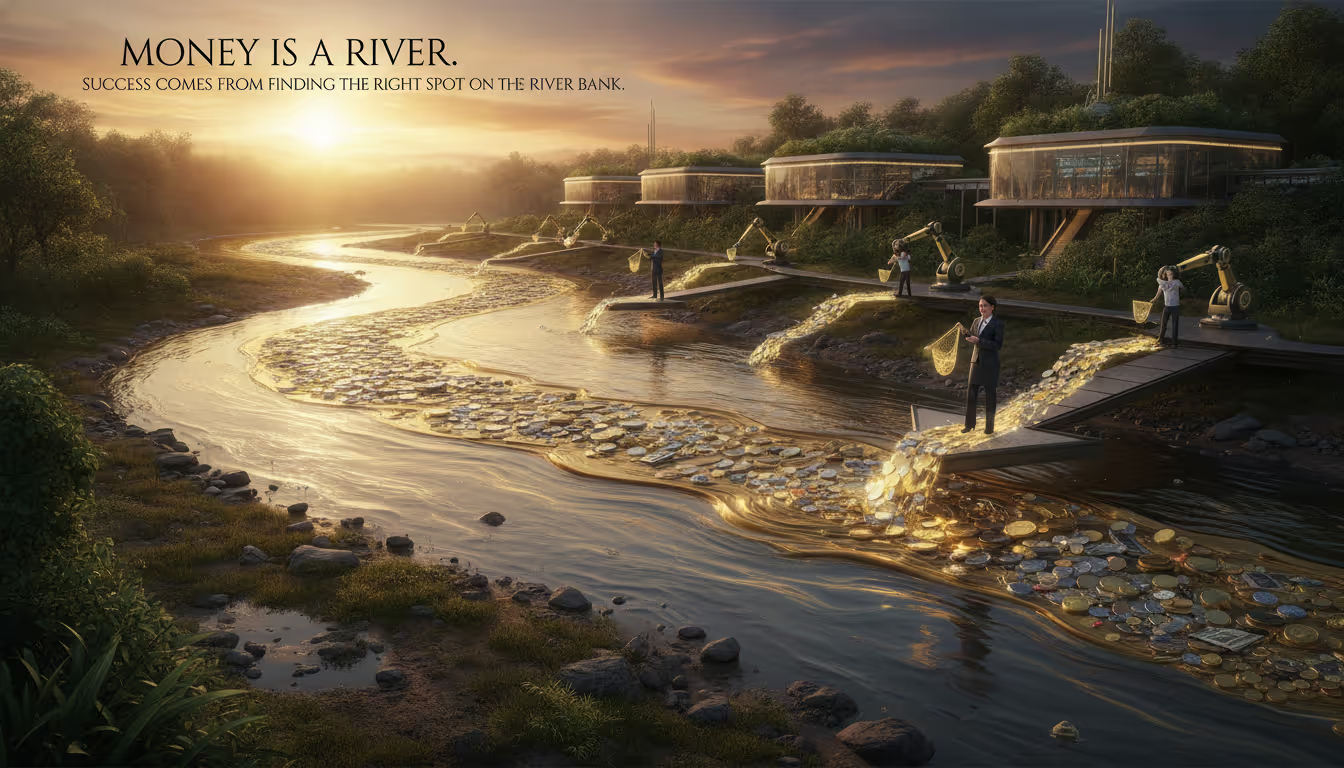
There is an island in the Nile, just south of modern Cairo, where one of the most important instruments in the ancient world was not a weapon, a monument, or a machine, but a staircase. It descended in measured stone steps into the river, each level marked with the careful precision of people who understood that the fate of a civilisation could turn on the height of water against rock. This was a nilometer, and for centuries it did something both humble and astonishing: it translated the Nile into a number.
The priests and officials who maintained these instruments did not control the river. They did not command the rains in the Ethiopian Highlands, where the annual flood began. They did not sculpt the valley that funnelled the water northwards through desert, nor did they cause the black silt to settle over the floodplain, making Egyptian agriculture possible. The river had been doing these things before Egypt existed and would continue long after dynasties had disappeared into sand. Yet the people who read the nilometer held a peculiar kind of power, because they stood at the place where the future first became visible.
A reading of roughly sixteen cubits meant something close to blessing. The flood would probably be generous without being destructive. The soil would be renewed. Farmers could plant with confidence. Granaries would fill. Taxes could be collected without provoking revolt. The machinery of the state could proceed. A lower reading, closer to fourteen cubits, meant an entirely different year was coming. Before famine appeared in the fields, it appeared as a measurement on stone. Above eighteen cubits, abundance became threat. The same river that fed the kingdom could wash away villages, wreck irrigation works, and turn prosperity into catastrophe. The nilometer did not create any of these outcomes. It simply revealed, earlier than almost anything else, which version of the future had already begun.
That is the part worth lingering over. The nilometer did not predict the future in the mystical sense. It did not divine what might happen from omens or stars. It measured something real, something already in motion. The rains had fallen. The tributaries were swollen. The water was coming. What mattered was not whether anyone could make the Nile rise, but whether anyone could read the rise soon enough, accurately enough, and with enough wisdom to act before the rest of the world felt the consequences.
We have been telling the wrong story about where economic power comes from. We say it comes from production, invention, effort, hustle, courage, obsession, vision. There is truth in all of that, but it is not the first truth. The Nile suggests something older and less comfortable: the river was always going to rise. The question was whether you were standing at the gauge when it did, and whether you understood what the number meant.
Modern business culture has almost no patience for this idea. It prefers its success stories heroic. The founder saw what no one else could see, worked while others slept, ignored the sceptics, bent reality to his will, and created a market out of nothing. The language is almost theological. Entrepreneurs “summon” demand, “disrupt” industries, “change the world.” Failure, by implication, becomes a defect of character: not enough courage, not enough grind, not enough conviction. The story is flattering to winners and punishing to everyone else, which is why it survives. But it is also an incomplete explanation of how money actually moves.
Cash moves through the economic landscape the way water moves through a watershed. It does not move randomly, and it rarely moves simply because one person wills it there. It follows gradients created by forces that predate the entrepreneur: technology cycles, regulatory structures, consumer habits, infrastructure, geography, culture, demography, credit conditions, institutional trust, boredom, fear, vanity, convenience, and need. These are not decorations around the business. They are the climate and terrain through which the business must operate.
The same entrepreneur with the same idea in 1995 and 2005 is not standing in the same world. In one year, the climate may be dry. In another, the rain may have already begun. The dot-com graveyard is full of people who were not stupid. Many were directionally right about what the world would eventually become. They understood online commerce, digital media, network effects, and remote services before those terms became commonplace. Their mistake was often not intellectual but meteorological. They saw the valley correctly and misread the weather. The rain had not yet fallen in sufficient volume. Broadband was thin. Payment systems were primitive. Consumer trust was fragile. The climate could not yet sustain the river they imagined.
Climate is the first force: the broad condition that determines whether it rains at all. Interest rates, consumer confidence, technological maturity, regulation, capital markets, social legitimacy — these decide whether the atmosphere is heavy with possibility or dry with constraint. In a wet climate, mediocre ideas can appear brilliant because the whole landscape is being fed. In a dry climate, excellent ideas can fail because there is not enough water to carry them.
Geography is the second force. It is the structural shape of the market: the slope of the land, the rock beneath the soil, the channels already carved by history and habit. Geography explains why money runs here and not there, why payments infrastructure attracts capital while some perfectly respectable service businesses never escape thin margins, why software swallowed some industries faster than others, why attention became more valuable than inventory, why platforms became richer than many of the producers they hosted. The entrepreneur does not arrive on a flat plain. He arrives in a landscape already shaped by decades of infrastructure, regulation, accumulated consumer behaviour, incumbent weakness, and institutional inertia.
Rain is the third force. It is the actual human desire that feeds the whole system: the need to save time, reduce friction, gain status, avoid embarrassment, entertain oneself, transact, belong, protect family, make money, spend money, and feel in control. Rain does not originate with the company. It falls because human beings are alive and wanting, restlessly and without end. No entrepreneur makes people desire convenience. No entrepreneur creates anxiety about status. No entrepreneur invents the desire to communicate, transact, compare, learn, escape, display, or be seen. Businesses capture these flows, shape them, accelerate them, and sometimes deepen them. But they do not create wanting itself.
This is why the first strategic question is not “What should I build?” It is “Where is the water coming from?” That question sounds less heroic than “How do I change the world?” but it is far more useful. It forces the entrepreneur to look outside himself. It requires the discipline of observation before action, of measurement before movement. It asks whether the river exists, whether it is growing, whether the terrain will concentrate or disperse it, and whether the builder has chosen a position where effort will be multiplied rather than exhausted.
Not all stretches of river are equal. This is where much of the mythology of business becomes actively harmful, because it pretends that companies compete mainly through effort and excellence, when often they are competing from radically different positions in the watershed. Two founders may work equally hard. One is building at a confluence, where separate currents combine and multiply. The other is digging in a stagnant floodplain. To praise one as a genius and blame the other as insufficiently committed is not analysis. It is moral theatre.
A confluence is where tributaries meet and the flow suddenly multiplies. Businesses that occupy confluences experience growth that often looks like genius but is partly geography. Amazon is the classic modern example, not because it found one river but because it repeatedly placed itself where several rivers were joining. In the 1990s, online retail was not a single force. It was the meeting of household computing, internet adoption, credit card penetration, logistics networks, consumer dissatisfaction with limited physical inventory, and a growing willingness to trust digital transactions. Bezos did not create all of that. He recognised that these currents were beginning to converge and chose a starting position — books — where the channel was unusually favourable. Books were standardised, easy to catalogue, relatively simple to ship, and numerous enough that physical stores could never carry everything. The river was not yet obvious to everyone, but it was already forming.
Then Amazon did something rarer. It kept reading the watershed. It moved from retail into logistics, from logistics into marketplace infrastructure, and from internal computing capacity into Amazon Web Services. AWS is instructive because it appears, at first glance, to be a different business entirely. But from the river’s point of view, it was another confluence: software companies needing scalable infrastructure, developers tiring of physical servers, venture capital funding internet businesses, and Amazon possessing hard-won operational knowledge from running enormous systems at scale. The company did not merely build beside a river. It learned to recognise where new tributaries were forming upstream.
Stripe offers a cleaner and more compressed example. By the time Patrick and John Collison began building it, the internet had already become astonishingly good at attracting customers and embarrassingly bad at taking their money. Developers could launch a website quickly, distribute software globally, and acquire users from anywhere, yet the moment they wanted to accept payments they were dragged into the ancient machinery of banks, merchant accounts, compliance processes, and clumsy integrations. Stripe did not invent online commerce. It did not create the desire to transact digitally. It built at the junction where modern software collided with legacy banking, and it made itself the bridge at exactly the moment when the water level was rising. That is confluence economics: arrive before the junction is fully legible, build the structure others will need, and allow the growing current to make the decision look inevitable.
The narrows are different. If the confluence is where water multiplies, the narrows are where it is constrained. Whoever controls the narrows controls passage. This is toll economics, platform economics, the logic of any business that inserts itself between supply and demand at a point where both sides must pass. Google did not build the internet, and it did not create human curiosity. What it built was the narrows of the internet: the place through which attention passed on its way to information, and through which commercial intent passed on its way to purchase. Once search became the route by which people navigated abundance, the search box became a sluice gate for attention. The margins available at such a point are extraordinary, because the company is not merely selling a product. It is governing passage.
But the narrows invite conflict precisely because their value is so legible. Everyone can see the toll bridge. Regulators see it. Competitors see it. Suppliers resent it. Customers tolerate it only while the passage remains useful. The greatest platform companies enjoy the economics of a narrows while living with the politics of one. Their profitability is a reward for occupying a constrained channel; their fragility comes from the fact that everyone downstream eventually begins looking for a way around them.
Then there is the bend, the subtlest and perhaps most overlooked position on the river. When a river bends, it loses velocity. As it slows, it drops what it carries. Silt settles. Heavy minerals fall. Over long periods, gold accumulates in predictable places. The gold panner did not put the gold there. The river deposited it. Yet the skilled panner is not merely lucky. He knows where rivers slow. He knows which curves matter, which gravel beds are worth testing, which patterns reveal invisible accumulation. He has learned to distinguish random digging from informed search.
Many excellent businesses are bend businesses. They are not glamorous enough to be called disruptive, and they do not always produce the spectacular valuations of confluences or narrows. But they understand where value quietly accumulates because a system slows down, becomes messy, or sheds opportunity at the edges. Accounting software for small businesses, compliance tools, niche workflow platforms, maintenance services, specialist logistics, boring B2B software — these often live at bends. The water is not roaring, but it is depositing value steadily for those patient enough to understand the curve. The entrepreneur here is not a prophet of the future but a reader of friction.
The delta, by contrast, is wide, diffuse, and difficult to capture. The river fans into countless small channels. The land may be fertile, but the current has lost force. Many businesses live in deltas: crowded local services, commodity retail, undifferentiated consulting, generic content, restaurants without a distinctive location or concept, small agencies selling what thousands of other agencies sell. There is money there, just as deltas can be rich agricultural land, but the economics are often punishing. Margins thin out. Competition is constant. Differentiation erodes. Energy dissipates before it can be harnessed. To build in a delta is not always foolish, but it requires unusual clarity about how one will avoid becoming merely another small channel in flat terrain.
Most business failure is not execution failure. It is location failure. Brilliant people row furiously in slow water. They attend the seminars, improve the branding, refine the offer, hire the coach, rebuild the website, optimise the funnel, and wonder why nothing compounds. The answer is sometimes brutal: they launched in the wrong stretch of river. Their effort is real. Their intelligence is real. Their perseverance is real. But the water is not.
This is not an argument against agency. It is an argument against romantic agency, the kind that pretends landscape is irrelevant because effort is morally attractive. The truth is more demanding. If the river is not yours, then your first responsibility is to become less intoxicated with your own plan and more attentive to reality. The entrepreneur’s real decision is not how hard to row. It is where to launch.
There are, of course, stretches of river where the problem is not scarcity of current but excess of it. Rapids and waterfalls are both created by underlying geology — hard rock, sudden gradient, a ledge in the riverbed that accelerates the water. Neither is created by the person in the boat. Both can be read in advance by someone who knows what to look for. They are the zones where opportunity and danger become almost indistinguishable.
Rapids are continuous turbulence. The water is fast, the course unstable, the risk of capsize real, but extraordinary ground is covered in little time. Early fintech operated like this. So did the first decade of cloud infrastructure. So does the current AI buildout. Companies in rapids feel permanently reactive because they are. Customers change expectations quickly, capital floods in and out, regulation struggles to keep up, competitors appear overnight, and the technical frontier moves while the product is still being built. This is exhilarating only in retrospect. At the time, it feels like steering while the boat is already half full of water.
Yet rapids are productive precisely because of their velocity. Enormous markets can form quickly where technology, capital and demand accelerate together. The founder in rapids is not merely solving a business problem; he is testing temperament. Some people are constitutionally unsuited to fast water. They freeze, over-correct, exhaust their teams, confuse turbulence with failure, or mistake motion for progress. Others develop an almost physical feel for the current. They know when to paddle, when to steer, when to let the water carry them, and when to get out before the next drop. This is one reason venture capital has such a distinctive psychology. Ecologically, it is the institutional funding of rapid-runners and waterfall-jumpers. Most will capsize. A few will travel so far, so quickly, that the downstream landscape changes for everyone.
Waterfalls are different because they are discontinuous. A waterfall is a ledge where the river ceases to be a faster version of itself and becomes something else entirely. The internet was a waterfall for media, retail and advertising. Broadband was a waterfall for video. The smartphone was a waterfall for social behaviour, photography, navigation, payments, dating, publishing and work. Artificial intelligence may become a waterfall for knowledge work, or it may fragment into a series of rapids and side channels; the point is not to declare the outcome in advance, but to recognise the type of terrain.
Netflix did not cause broadband. It read the geological survey correctly. It understood that once high-speed internet became sufficiently widespread, the business of moving entertainment through physical objects would be standing at the edge of a ledge. Blockbuster did not fail because its employees lacked work ethic. Kodak did not fail because it had never heard of photography. Newspapers did not fail because journalists stopped writing. These organisations encountered a waterfall and interpreted it as a rough patch of ordinary river. They tried to improve the boat when the problem was the drop.
There is always a portage option. One can leave the river, carry the boat overland, and re-enter downstream. Incumbents sometimes do this successfully. They abandon legacy revenue, cannibalise themselves, change models, rebuild capabilities, and accept a painful crossing in order to survive. But portage is slow and humiliating, especially for companies that once owned the channel. Many prefer to stay seated, insisting the river will flatten out again, until the roar becomes too loud to deny.
If entrepreneurs are river readers, financial institutions are dams. This sounds accusatory, but it need not be. Dams were always going to be built. The accumulated energy of a river is too powerful not to attract structures designed to store, redirect and release it. Banks, lenders, venture funds, private equity firms, exchanges, insurers and capital markets are not incidental to the economic watershed. They are permanent features of it. They do not create the water, but they decide who receives it, at what cost, in what volume, and under what conditions.
A well-operated dam can make the whole downstream ecology more productive. It smooths extremes, stores surplus, releases capital into dry areas, funds bridges and irrigation, and makes long-term planning possible. Civilisation depends on some form of intermediation because raw flow is too volatile. The problem is not that dams exist. The problem begins when the logic of the sluice gate becomes detached from the health of the river. Control of flow has a gravitational pull of its own. It can become profitable to manage scarcity rather than abundance, to preserve opacity rather than legibility, to make the downstream world dependent on decisions it cannot see and measurements it cannot verify.
The nilometer was powerful because it made the river legible. A closed sluice gate is powerful because it can make the river illegible. When businesses cannot tell whether drought is caused by weak demand, withheld credit, platform rules, investor fashion, regulatory shock or a change in consumer behaviour, they are no longer reading the water. They are guessing in fog. Opacity is how drought begins before anyone declares one.
The same ecological lens helps explain platform monopolies. River ecologists have a term for what happens when one species colonises the richest stretch of bank and crowds out the rest: competitive exclusion. The invader may flourish, but the ecosystem becomes less resilient. Diversity disappears. The river still flows, but what it sustains becomes narrower. Platform monopolies operate in a similar way. They do not own the water. They occupy the best bank, fence access to it, and insert themselves as the necessary mediator between the current and everyone who needs it.
This is not merely a moral complaint, although moral complaints may be justified. It is an ecological diagnosis. A monoculture can be highly productive in the short term. It can optimise beautifully for yield, efficiency and control. But monocultures are brittle. They reduce the experiments, redundancies, cross-pollinations and small adaptive failures that make systems durable. A business ecology dominated by a few platforms may look efficient, just as a riverbank planted with a single crop may look orderly. The weakness appears later, when conditions change and there is not enough variety left to respond.
At this point, the obvious objection arrives. What about the people who do not merely read the landscape but reshape it? What about Bezos building new tributaries, Musk forcing electric vehicles and private spaceflight into markets that seemed unwilling to sustain them, or the Dutch turning water management into a civilisation-scale art? Surely some actors do more than stand at the gauge. Surely some cut canals, raise levees, drain marshes and redirect the future.
They do. But they do not escape the rule. They intensify it. Every serious landscape architect reads first. The Dutch did not become wealthy by pretending water did not matter. They became wealthy because they understood it with unusual seriousness. Their ports, canals, polders, dikes and trading networks were not acts of defiance against geography so much as disciplined negotiations with it. They studied the existing flow and then altered the terrain carefully enough to make new forms of life and commerce possible. Canal builders in the eighteenth century did the same. They did not begin by drawing heroic straight lines across maps. They studied elevation, drainage, existing rivers, trade routes, locks, rainfall, soil and demand. Engineering followed observation.
The same is true in business. The rare companies that reshape markets do so because they understand the existing watershed better than those trapped inside it. Amazon could build new tributaries because it first understood the confluence. Tesla could challenge the car industry because it read not only consumer aspiration, but battery curves, regulatory pressure, software potential, brand desire and institutional complacency. The landscape architect is not the opposite of the river reader. He is the river reader carried to an extreme: someone who reads so deeply that he sees where the channel itself can be altered.
But this is rare. Far more common is the entrepreneur who mistakes desire for water. He has a product, a pitch deck, a personal story, a refined brand, a theory of the customer and a great deal of sincerity. What he lacks is evidence of flow. The market does not care how meaningful the idea feels to the person who conceived it. Rivers are indifferent to sincerity. They move where gravity, terrain and volume compel them to move.
This may be the hardest lesson in business because it offends both ego and morality. We want effort to be rewarded because effort is visible and morally satisfying. We want vision to matter because vision flatters the visionary. We want failure to be explainable as avoidable error because that makes success feel controllable. But economic life is not a classroom where marks are awarded for diligence. It is a landscape. The landscape has slopes, barriers, seasons, floods, droughts, bends and hidden deposits. To ignore them is not brave. It is childish.
The better posture is humbler and more powerful. It begins by asking where the water is coming from. What climate is changing? What human desire is intensifying? What infrastructure has recently become available? What old institution is becoming brittle? Where is friction accumulating? Where are two systems beginning to collide? Where is velocity increasing? Where is the river slowing down and dropping value for someone patient enough to collect it? Where is the delta too diffuse to capture? Where is the narrows too contested to enter? Where is the confluence still early enough to build?
These questions are less glamorous than slogans about disruption, but they are much closer to the work. They also restore a healthier relationship between luck and skill. The gold panner did not create the gold, but neither is he merely lucky if he consistently finds it. The nilometer priest did not create the flood, but neither is his knowledge trivial. The entrepreneur did not create the rain of human desire, the climate of technology, or the geography of markets, but skill still matters enormously. It matters in reading, timing, positioning, interpretation and response.
Perhaps this is what we should mean by strategy. Not a plan imposed upon reality, but a disciplined reading of reality before action. Not the fantasy that the river belongs to us, but the ability to stand at the gauge before others arrive, notice the height of the water, and understand what follows.
The priest at the nilometer did not make the Nile rise. He did not cause the rains in the highlands, did not shape the valley, did not command the silt to settle on Egyptian fields, and did not build the delta that made the civilisation possible. The river did all of that. Yet almost every important decision downstream depended on someone reading the water early and accurately enough to act.
We tend to celebrate the people in the fields, the builders of granaries, the commanders of barges, the rulers who taxed the harvest and carved their victories into stone. They matter. But before the harvest, before the tax, before the granary, before the monument, there was a measurement. There was water against stone. There was a reader who understood that the future had already begun moving towards them.
The greatest fortunes in history have rarely been built by creating water. They have been built by recognising where the landscape had already decided the river would run.
The river was never yours.
But for a time, if you read it correctly, it may run exactly where you need it to.


