
You kneel by the hospital bed, or you sit in the car park before the meeting where you're about to lose the contract, or you stare at the second glass of wine and ask, quietly, for the thing to change. The diagnosis to reverse. The number in the account to be different. The marriage to un-break itself while you weren't looking. That is prayer, in its most honest form — not liturgy, not incense, just a person asking for a specific outcome because the alternative is unbearable.
And the promise — the actual, textual, repeated-across-both-Testaments promise — is not that you get the outcome. It's that you get wisdom.
If your first reaction to that is something close to insult, you have understood the deal precisely. Nobody kneels in a car park asking for wisdom. They ask for the contract. Wisdom is what you get instead, and for a long time I assumed that was scripture's way of managing expectations — a theological consolation prize, dressed up in old language so it sounds more dignified than it is. I don't think that anymore. But you have to take the substitution seriously before you can see why it isn't one.
Here is the scene, in case Sunday school didn't stick. Solomon is newly crowned — not through merit exactly, more through the usual bloody arithmetic of court succession — and he goes to Gibeon to make sacrifices, and that night God appears to him in a dream and says, essentially, name your price. Ask what I shall give thee. Not "what do you need." Not "what would help the kingdom." Ask what I shall give thee — a blank cheque from the only entity in the universe capable of honouring it.
Think about what you'd write on that cheque. Most of us wouldn't need thirty seconds. Health for someone we love. The court case to go our way. The business to survive the quarter. Solomon — a young king inheriting a fragile throne from a father who'd spent his whole life fighting to hold it together — had every reason to ask for military strength, or long life, or the death of his enemies. Those aren't unreasonable requests. They're the requests his father David would have made without blinking.
Instead Solomon asks for an understanding heart, so that he can judge the people and discern between good and bad. Not gold. Not victory. Not even certainty. He asks for the capacity to tell the difference between things — which, if you sit with it, is a strange and almost unglamorous thing to want more than anything else in the world.
And the part everyone skips past too quickly is what happens next: because he didn't ask for long life, or riches, or the lives of his enemies, but asked for understanding, he gets the wisdom — and the riches and honour get thrown in besides, as an unrequested bonus. Which tells you something this whole essay is going to keep circling back to. The things we actually want tend to arrive, if they arrive at all, as a side effect of asking for the right thing. They almost never arrive as the direct result of asking for themselves.
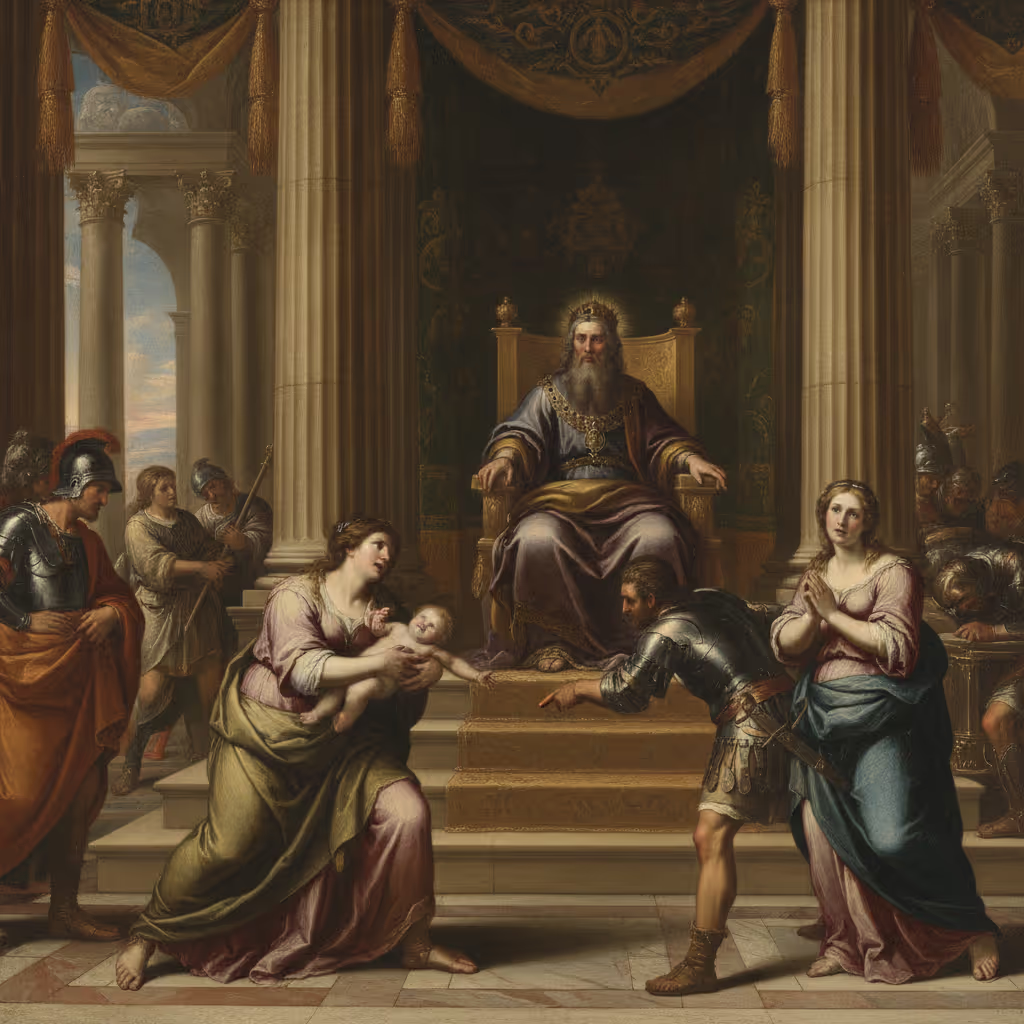
You get to watch what that understanding heart looks like in practice almost immediately, because the next story in the text is the two women, the one dead baby and one live one, and Solomon's method for finding out which mother is lying: cut the child in half. It isn't a solution. It was never meant to be executed — it's a trap, built to expose which woman would rather lose the child whole to a stranger than see it destroyed, and which one only ever wanted the win. That's phronesis with the paint still wet. Not a principle recited in a boardroom. A working mechanism, applied to two people, in a room, with a sword actually being sent for.
This isn't a one-off Old Testament anomaly, a nice story about a particularly humble king. James — writing centuries later to a scattered, broke, frightened community of believers who had every reason to ask for money or safety — tells them: if any of you lacks wisdom, ask of God, who gives to all generously. Not "ask for deliverance." Not "ask for provision." Ask for wisdom, specifically, because that's the one request God has actually committed to filling without hesitation or rebuke.
And it isn't only a biblical pattern. It might be the oldest story we have. Gilgamesh, in the oldest epic anyone has ever dug out of the ground, watches his friend Enkidu die and is so undone by the sight of it that he walks out of his own city and across the edge of the known world looking for exactly one thing: the secret of not dying. He gets there. He finds the plant of immortality, weighted to his ankles at the bottom of the sea, and for about a page of a four-thousand-year-old poem you actually believe he's going to win. Then a serpent eats the plant while he's bathing, and he loses the one thing he crossed the world to get.
What he brings home instead isn't immortality. It's Uruk — the walls of his own city, seen properly for the first time, the thing he'd had all along and never actually looked at. The epic doesn't end with Gilgamesh grieving the lost plant. It ends with him standing on the wall, essentially saying: look what we built, look how this endures beyond any one of us. That's not a consolation prize bolted onto a failed quest. The Sumerians who first told that story already understood something that keeps reappearing every time people write down what they've learned about wanting things — the specific object of the quest is very rarely the actual education. The quest is.
So we have a Mesopotamian king, an Israelite one, and a Judean letter-writer, centuries and cultures apart, converging on the same strange substitution. Which means it's worth asking the obvious, slightly embarrassing question: what is this thing we're being handed instead of what we wanted? Because if we don't know, we're going to keep mistaking the substitution for a rejection.
—
Start with what it isn't, because that's usually the faster road to what something is.
Wisdom is not intelligence. This should be obvious and somehow still needs saying every generation, because every generation produces its own crop of brilliant people who mistake processing speed for depth. You know the type — can hold six variables in their head at once, can win the argument, cannot hold a marriage together or work out why they're miserable at the top of the organisation they built. There's a reason Good Will Hunting spends its whole runtime on a janitor who can solve graduate-level maths on a whiteboard between shifts, and still needs an old, grieving therapist to sit with him in a park and tell him, more or less, that being able to recite the contents of every book in the library isn't the same as having lived a single page of one. Will's genius is real. It's also, on its own, useless to him — worse than useless, because it gives him an excuse to keep believing that understanding a thing and being changed by it are the same activity. They're not. Knowledge sits in your head. Wisdom has to get into your hands.
The Greeks told the same story about a man with wings instead of a whiteboard. Daedalus builds Icarus a genuinely brilliant piece of engineering — feathers, wax, a working escape from an inescapable island — and gives his son exactly one instruction along with it: not too low, or the sea-damp weighs the feathers down, and not too high, or the sun melts the wax. That instruction is the wisdom. The wings are the knowledge. Icarus takes the knowledge and leaves the instruction behind the moment he's airborne and drunk on how well the thing works, and ends up in the sea that still carries his name. Nobody doubts Daedalus built good wings. The wings were never the problem. The boy holding them had capability with no governor fitted to it, and gravity doesn't negotiate with talent.
Wisdom is also not something to be worshipped for its own sake, which is a harder trap to see because it dresses itself up as virtue. The Gnostics — and I use that word deliberately, because it's the right one, not because it sounds impressive — built entire theological systems around the idea that secret knowledge, gnosis, was itself the path to transcendence. Know the right thing, possess the right hidden information, and you rise above the ordinary mess of living. It's an old con and it never really goes away; it just changes costume. The modern boardroom version is the executive who's read every leadership book published in the last decade and can quote frameworks at you all afternoon, treating the accumulation of models as though it were itself an achievement. It isn't. A framework you can recite but won't apply is a rosary you're fondling instead of praying. Wisdom used correctly disappears into the decision. You don't see it. You see the decision.
Babel is the same trap at civilisational scale, and it's usually taught wrong — the sin at Babel was never height. It was the stated motive: let us make a name for ourselves, lest we be scattered. A whole city pooling its knowledge and its brick-technology, not to build something worth building, but to manufacture permanence and reputation out of raw capability. God doesn't send a plague or an army. He just confuses the language, which is a strange, almost gentle punishment until you realise what it actually does — it breaks the illusion that shared technical competence was ever the same thing as shared wisdom. You can stand shoulder to shoulder with someone, speaking the same professional dialect fluently, agreeing on every KPI, and still be building a tower neither of you should be building.
I bring this up because the modern equivalent isn't a brick tower. It's the industry that sells you the framework instead of the judgement. Walk into enough boardrooms and you'll meet the consultant who's turned wisdom into a deliverable — a four-quadrant matrix, a laminated one-pager, an acronym that spells something clever. None of it is fraudulent, exactly. Most of it is even true, in the way a horoscope is true — vague enough to fit whatever situation you hold it up against. But a framework sold at scale to a thousand different companies cannot, by definition, contain the specific discernment your specific business actually needs this quarter. That has to be earned in the room. Anyone offering to skip that part for a fee is selling you a name plate for a tower nobody needed.
Wisdom is not feelings, either — and I want to hold this one carefully, because it's where a lot of writing on this subject, including an earlier draft of this very essay, gets lazy. It's easy to say wisdom isn't emotional and mean, by implication, that wisdom is cold. Stoic. A man standing very still while the house burns, unmoved, because he's transcended the messy business of feeling anything about it. (I don't believe that, and I used to write as if I did, which is its own kind of confession.) That isn't wisdom. That's a personality disorder wearing wisdom's clothes.
Go and read Job properly, not the Sunday-school summary where a patient man endures and gets rewarded. Job rages. He accuses God to His face of being unjust, curses the day he was born, refuses every tidy explanation his three friends offer him — and none of that fury gets rebuked. What gets rebuked is the friends' cheap certainty, their need to have the answer tied up before they've sat in the grief long enough to earn one. When God finally answers Job out of the whirlwind, He doesn't explain the suffering. Not once. He doesn't resolve a single one of Job's actual questions. He shows Job the scale of the universe instead — the wild goats giving birth on the cliffs, the war horse who laughs at fear, the leviathan nobody can leash — and somehow that's the wisdom. Not an answer. A frame wide enough to hold the grief without needing to solve it.
Scripture doesn't only make this room once, in one long book about one uniquely unlucky man. Buried in the middle of the Psalms — the actual hymnbook, the songs an entire worshipping people were meant to sing together — is Psalm 88, which starts in darkness and never once turns the corner. No pivot to praise in the final verse, no "but I will trust," no tidy resolution. It ends, more or less, on the image of darkness as the psalmist's closest companion. That psalm was kept. Someone decided, deliberately, that unresolved grief belonged in the permanent liturgy of a worshipping people, and wasn't edited out for making everyone uncomfortable. If the tradition itself can hold a song that never gets better, you can probably stop demanding that your own wisdom arrive pre-resolved.
That's the emotional register wisdom actually operates in. It doesn't ask you to stop feeling the thing. It asks you to feel it inside a frame large enough that the feeling doesn't run the whole show. Solomon himself, decades after Gibeon, writes an old man's book — Ecclesiastes — that is basically one long, gorgeous, weary sigh: he has seen everything under the sun, and it is vanity, and the wise man dies just the same as the fool. That isn't a failure of his earlier wisdom. That's what wisdom sounds like from the far end of a life, once it's metabolised enough loss to have something honest to say about it. If your model of wisdom can't accommodate an old king being genuinely, unglamorously tired, your model is too small to be useful.
And finally — wisdom is not automatically issued just because it was promised. This is the part the marketing version of faith likes to skip. James says ask and it will be given, and that's true, but "given" doesn't mean downloaded, fully installed, no further action required.
Bill Murray's weatherman in Groundhog Day gets an enormous amount of time to acquire knowledge — he learns piano, he learns ice sculpture, he learns the exact sequence of every pratfall and near-miss in a small Pennsylvania town, he could sit an exam on Punxsutawney and score perfectly. None of it ends the loop. What ends the loop isn't information. It's the day he stops using the repetition to get something for himself — the girl, the escape, the win — and starts using it to actually attend to the people around him, without an angle. The knowledge was available on day two. The wisdom took him hundreds of days, because wisdom isn't a fact you acquire. It's a posture you get worn into, usually against your will, usually slower than you'd like.
—
So if it isn't cleverness, and it isn't a trophy to mount on the wall, and it isn't cold detachment from feeling, and it isn't handed over complete the moment you ask — what is it?
Here's the closest I can get to a definition, stated plainly, because hedging on the central claim is a coward's move: wisdom is what happens when faith and knowledge are forced to occupy the same body. Knowledge on its own is inert — raw ore, sitting there, true and useless. Faith on its own, without knowledge to give it shape, curdles into superstition, or worse, into the kind of confident stupidity that gets people and companies killed. I've watched a founder pray over a cash-flow problem instead of reading the cash-flow statement, genuinely convinced that sincerity alone would move the number, and it never once occurred to him that faith without the knowledge of his own numbers wasn't faith. It was avoidance with a hymn attached. You need both, welded together under actual pressure. And the welding isn't a metaphor I'm reaching for to sound literary — it's the only honest description I've got for how the thing is actually made.
The Greeks had two separate words for what we lazily lump together as "wisdom," and the distinction is worth stealing. Sophia was the contemplative kind — the wisdom of the philosopher staring at first principles, working out what's eternally true. Phronesis was the practical kind — the wisdom of knowing what to do, right now, in this particular mess, with these particular people, where the textbook answer and the correct answer have quietly become two different things. Solomon at Gibeon didn't ask for sophia. He asked for phronesis — an understanding heart to discern, in the room, with a sword already sent for. That's not abstract virtue. That's a specific, practical problem with a specific, practical stake, and the wisdom he was given was built to solve exactly that kind of problem, not to win a debate at the Lyceum.
Faith, once you stop treating it as a synonym for blind hope, breaks down into three moving parts, and it's worth separating them, because collapsing them is where most people's collapse actually happens.
The first is belief, and belief is built out of frames, not facts. Send twelve men into Canaan to scout the same land and you'll get twelve different reports, because a scouting report is never really about the land — it's about the scout. Ten of them come back and say there are giants, and we were like grasshoppers next to them, and the report isn't wrong, exactly; there probably were large men in Canaan. But two of them — Caleb and Joshua — looked at the identical terrain, the identical fortified cities, the identical giants, and came back saying the land is exceedingly good, and if the Lord delights in us, He will bring us in. Same data. Opposite conclusion. The difference wasn't information. It was the frame the information got poured into.
That's not a comfortable fact, because it means two people can stand in the exact same set of circumstances — the same collapsing market, the same diagnosis, the same failing marriage — and one will see grasshoppers and the other will see a way through, and neither of them is lying about what they saw. They're reporting through different apparatus. Your frame decides, before a single fact arrives, roughly what kind of facts you're even capable of noticing.
The second part is conviction, which is not belief's volume knob so much as its spine. Belief tells you what's true. Conviction is what's left of that belief when it's three in the morning and the furnace is actually lit.
I mean that literally, because the best illustration of it is literal. Shadrach, Meshach and Abednego are told to bow to the king's statue or burn, and their answer to the king isn't "we're sure God will save us" — read it again, that's not what they say. They say our God is able to deliver us, and He will deliver us — and if not, be it known to you, we will not serve your gods. Sit with that "if not." They walk toward the furnace without a guarantee. Their conviction was never actually resting on the outcome; it was resting on who they were regardless of the outcome. That's the tell for real conviction versus rehearsed optimism — optimism collapses the moment the ending isn't the one it was promised. Conviction doesn't need the ending. It's already decided who it's going to be either way.
This is, not coincidentally, the exact place most people's faith actually breaks — not at the level of belief, where it's easy to nod along in a church or a boardroom, but at the level of conviction, where the furnace is real, the outcome isn't guaranteed, and you find out, uncomfortably, whether you meant any of it.
None of which makes conviction the same thing as stubbornness, and it's worth separating the two, because they get confused constantly — usually by people mistaking their own inflexibility for depth of faith. Stubbornness digs in regardless of new information, because digging in has become the identity. Conviction digs in on who you are while staying completely open about what happens next. The three men in the furnace weren't refusing to hear an argument; they were refusing to trade their identity for an outcome. There's a world of difference between "I won't be moved because I refuse to consider I might be wrong" and "I won't be moved because moving isn't who I am, whatever the furnace decides." The first is ego wearing faith's coat. The second is the actual thing.
The third part is action, and action is where belief and conviction stop being able to hide. You can hold a belief silently forever. You cannot act silently — action is the one part of the triad that's visible to other people, which is exactly why it's the part most often faked, and exactly why it's the part that matters most.
Mr Miyagi never once sits Daniel down and explains the theory of muscle memory or rotational hip mechanics. He hands him a rag and a bucket and says wax on, wax off, and has the kid polish cars for days on end, for reasons the kid isn't told and doesn't understand — and the wisdom of it only reveals itself later, in the body, when the block comes up on reflex because the reflex was built through ten thousand small, boring, unexplained repetitions. Jesus tells almost exactly the same story with a different prop: the wise man builds his house on rock, the foolish man builds his on sand, and the deciding factor isn't which of them heard the sermon — they both heard the same sermon — it's which of them went and did something about it before the rain came. Wisdom that stays upstairs in the belief and never comes down into the hands is not wisdom. It's an opinion with good posture.
—
Take that triad out of the temple and the therapist's office and put it to work in an actual organisation, because that's where most of us are going to have to use it, and the shape doesn't change — only the vocabulary does.
Circumstantial awareness is framing applied to a market instead of a promised land: the discipline of reading what's actually in front of you without the distortion of what you're afraid of, or what you're hoping for. Most strategic failure I've watched up close wasn't a failure of intelligence. It was ten scouts and two scouts looking at the same balance sheet.
I watched this play out with a retail client staring at declining foot traffic. Half the room read it as death — close stores, cut headcount, brace for the end. The other half, looking at the identical trend line, saw the actual signal underneath it: the customers hadn't disappeared, they'd moved their browsing online and kept their buying local, which is a completely different problem with a completely different fix. Same chart. Same quarter. Two frames, and only one of them pointed at a strategy that worked.
Acceptance is conviction applied to the things you cannot change — and there's an old prayer built around exactly this move: ask for the calm to leave alone what won't budge, the nerve to move what will, and the last request, always last, is for enough judgement to tell one from the other. That prayer isn't sentimental. It's an operating manual. Half the exhausted founders I've sat across from are burning themselves out fighting conditions that were never going to move, while the actual lever sat two metres to their left, untouched, because acceptance felt like defeat and nobody had told them the difference. One of them spent eighteen months trying to out-negotiate a supplier contract that was structurally never going to improve, when the actual fight was always available two doors down, in the margin he could still control. Redirecting the effort wasn't losing. It was discernment wearing an unfamiliar coat.
Discernment is what Solomon actually asked for, scaled down to Tuesday — the capacity to know, in this specific case, with these specific people, what the real leverage point is. Not the leverage point that worked last time, in the last business, for the last client. This one. Ecclesiastes says there's a time to plant and a time to uproot, a time to build up and a time to break down, and the entire difficulty of running anything is that the calendar doesn't announce which time it currently is. You have to discern it, usually with incomplete information, usually under pressure, usually while someone in the room is convinced it's a different time than it actually is.
I've sat in the room where the argument was genuinely symmetrical — one voice insisting it was time to double down on a struggling product line because the fundamentals were sound and patience was the virtue required, another insisting it was time to kill it because sunk cost was dressing itself up as patience. Both arguments were internally coherent. Both cited the same revenue numbers. The discernment wasn't in the data; the data was identical for both sides. It was in someone finally asking the sharper question underneath the argument — not "can this survive" but "would we start this today, from scratch, if we didn't already own it" — which is usually the fastest way to tell a plant-season decision from an uproot-season one, because sunk cost never survives that question and genuine long-term value usually does.
And righteous execution is action again, doing the thing rather than merely knowing it — the only part of the whole equation that leaves a visible trace. You either did the right thing or you didn't, and no amount of retrospective framing changes what actually happened in the room. This is also, not coincidentally, the part people try hardest to skip, because it's the only part with witnesses. You can rewrite the story of what you believed after the fact. You cannot rewrite what you actually did in front of the people who watched you do it.
None of this, to be clear, makes the ride painless. This is the part people miss when they hear "wisdom" and imagine something serene. Solomon received the wisdom at Gibeon and still, decades later, married his way into idolatry and watched his kingdom start cracking under the weight of his own appetite — the same book that tells you how wise he was tells you that part too, right after, and it doesn't flinch from the contradiction, so neither should you. Being granted wisdom once is not the same as remaining wise on a Tuesday. It has to be re-chosen, continually, usually right at the moment you're least inclined to choose it — which is precisely when Job's fury, and Kohelet's exhaustion, and your own three-in-the-morning bargaining all belong inside the frame, not outside it. A wisdom that requires you to stop feeling in order to qualify for it isn't wisdom. It's anaesthesia with better branding.
Solomon didn't get to keep his kingdom intact forever, and Gilgamesh never did stop dying, and the person praying over the hospital bed doesn't always get the reversal either. None of these stories end with the specific thing rescued. They end with someone left standing who can tell you, honestly, what it cost and what it meant — which is a different kind of ending than the one we usually pray for, and a better one than we usually admit.
So go back to the car park, or the hospital corridor, or the kitchen table at midnight with the bank statement open in front of you. You asked for the specific thing. The contract. The reversal. The marriage un-broken. And maybe it didn't come — plenty of the time, in my own experience and everyone else's I've watched closely, it doesn't.
What you're promised instead is not a consolation prize dressed up in religious language to soften a rejection. It's the only thing that was ever actually going to help you regardless of which way the specific thing went — an understanding heart, a frame wide enough to survive the news, a conviction that doesn't require the furnace to end well, and the hands to act rightly once you know what right actually looks like in the room you're standing in.
The contract may still fall through. The diagnosis may still be what it is. Wisdom does not promise you get to keep the thing you knelt down and asked for. It promises you get to keep yourself, standing upright, telling the truth about what happened, on the other side of not getting it. That was always the better deal. Most of us just don't recognise it until we're holding it instead of the thing we actually asked for.


