Napoleon's Russian Catastrophe and the Modern Crisis of Outdated Models
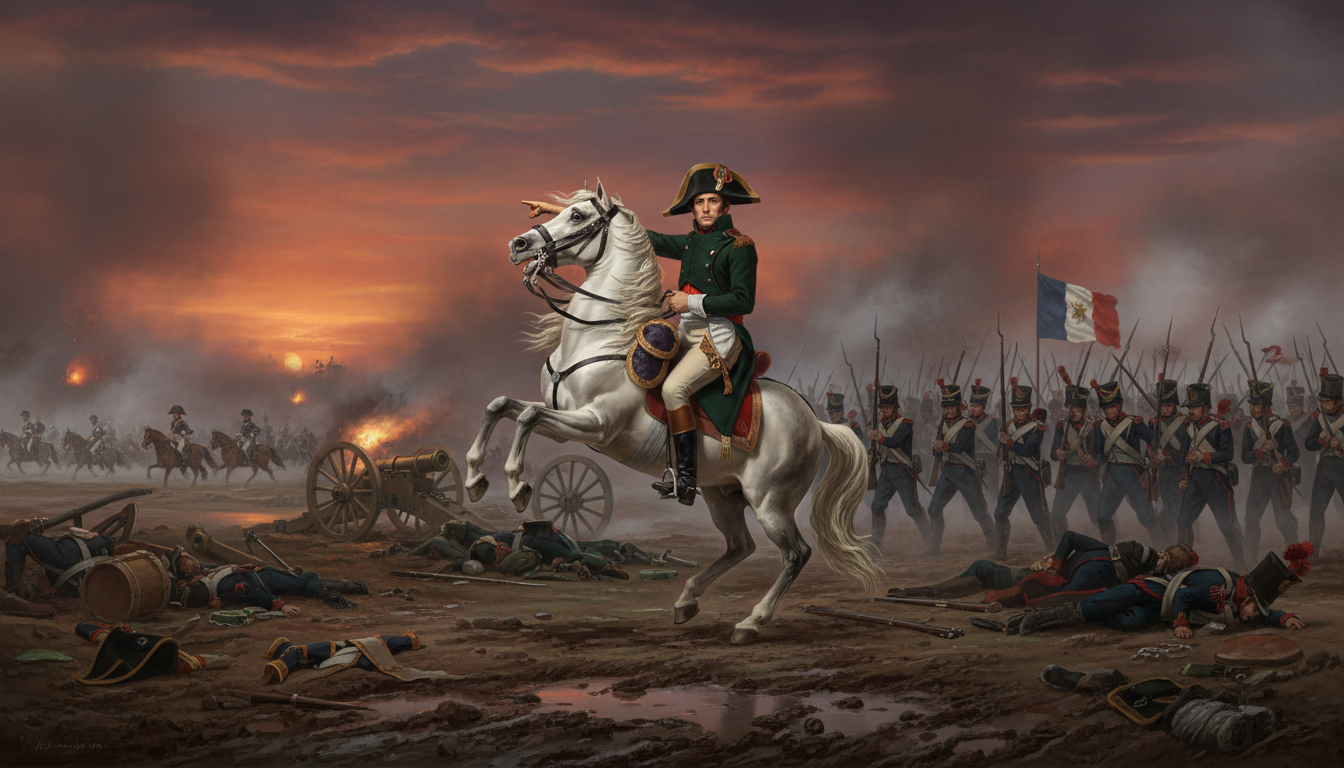
On 24 June 1812, Napoleon Bonaparte stood on the banks of the Niemen River, reviewing what was arguably the largest invasion force Europe had ever assembled. The Grande Armée—615,000 soldiers drawn from across the French Empire and its allies—stretched as far as the eye could see. Within six months, fewer than 100,000 would stagger back across that same river, many of them permanently crippled by frostbite, starvation, or the diseases that had ravaged them during their catastrophic retreat.
The destruction of Napoleon's Grande Armée in Russia stands as one of history's most devastating military disasters, claiming nearly a million lives when Russian casualties are included. But the real lesson of 1812 isn't simply about military strategy or winter warfare. It's about something far more fundamental and frighteningly relevant to our modern predicament: what happens when brilliant minds refuse to update their worldview in the face of a reality that no longer conforms to their cherished assumptions.
The Map That Led a Million Men to Their Deaths
Napoleon was no fool. He'd read accounts of Charles XII's failed Swedish invasion of Russia a century earlier. He understood the terrain was sparsely populated, lacked proper roads, and offered little in the way of supplies. He organised the most elaborate logistical operation of its time—7,848 supply vehicles, extensive magazines strategically positioned across Poland and East Prussia, five supply lines from the Rhine to the Vistula. As he wrote himself: "We can hope for nothing in that countryside, and accordingly must take everything with us."
Yet for all this preparation, Napoleon was operating from a map of warfare that had brought him spectacular success across Europe for over a decade. That map was built on certain fundamental assumptions: rapid, decisive battles; armies living off the land; enemies who, once defeated in the field, would come to the negotiating table; capital cities that, once captured, meant victory. This model had worked brilliantly in Austria, Prussia, and a dozen other campaigns.
Russia refused to play by Napoleon's rules.
Russian commanders, led by Barclay de Tolly and later Kutuzov, had developed their own map—one specifically designed to counter Napoleon's strengths. Rather than offer the decisive battle Napoleon craved, they retreated deeper into Russia's vast interior, destroying everything that could sustain the invading army. When Napoleon finally got his battle at Borodino on 7 September—the bloodiest single day of the Napoleonic Wars, with at least 70,000 casualties—the Russians simply retreated again, leaving Moscow open but worthless.
The emperor entered Moscow on 15 September with approximately 100,000 exhausted men. He found a city deliberately burnt by its own governor, abandoned by all but 2–3% of its population. He waited a month for Tsar Alexander to negotiate. The Tsar never came.
Here's the crucial point often missed in popular accounts: Napoleon's army was already destroyed before the legendary Russian winter truly set in. Just one month into the campaign, 80,000 soldiers had succumbed to typhus and dysentery—diseases spread by the lice-infested peasant cottages his soldiers pillaged for shelter. The scorching summer heat, putrid water from holes filled with dead cattle and people, and the clouds of dust from the army's march had devastated his forces long before the first snowfall on 6 November.
By the time Napoleon abandoned his army on 5 December and raced back to Paris to manage the political fallout, the Grande Armée had ceased to exist as a fighting force. Of the 612,000 men who'd entered Russia, only 112,000 would return. Of the French losses, 70,000 died in action, but 120,000 died from disease, starvation, and exposure—death by reality refusing to conform to the map.
The Meta-Level Failure: Why Genius Wasn't Enough
Napoleon's catastrophe wasn't fundamentally a failure of intelligence or courage. It was a failure of epistemology—of knowing when to question your own models. The territory had shifted, but he kept consulting the old map. His assumptions about how wars were fought, how enemies behaved, and how battles were won had become, in his mind, not models to be tested but truths to be relied upon.
This is the map-territory fallacy at the societal level, where the consequences multiply exponentially. When individuals make this mistake, they suffer. When commanders make it, armies perish. When entire civilisations make it, the results can reshape history.
And we're making it now, on a scale that dwarfs even Napoleon's hubris.
(And, it is not uncommon for us to NOT learn from our failures as a society.)
Our Modern Russian Winters: When Today's Maps Meet Tomorrow's Territory
The Financial Crisis: When Risk Models Became Graven Images
Consider the 2008 Global Financial Crisis—a catastrophe that wiped out $2 trillion in global growth and left millions jobless. At its heart was a spectacular failure of the models that were supposed to keep us safe.
For years, financial institutions had relied on Value-at-Risk (VaR) models to manage their exposure. These elegant mathematical constructs assumed normally distributed returns—a map that worked beautifully during calm periods. Banks used them to calculate how much they could lose on a given day with 99% confidence. Based on these calculations, they took on unprecedented levels of risk, leveraging their balance sheets to dizzying heights.
There was just one problem: the map was catastrophically wrong.
Traditional VaR models significantly underestimated the probability of extreme losses. They treated the housing market as if each bank existed in its own universe, failing to account for what happened when all banks followed similar strategies simultaneously. When the crisis hit in mid-2007, these models performed dismally. Research examining five international markets found that during crisis periods, the simplified VaR approaches many institutions relied upon proved woefully inadequate.
The real issue wasn't the mathematics—it was that banks had mistaken their model for reality itself. They'd used overly simplistic copula models to estimate mortgage portfolio risks, failing to account for how default correlations behaved during crises. More than 13,000 AAA-rated tranches of structured products defaulted in quick succession—something the models said was virtually impossible.
JPMorgan's "London Whale" incident in 2012 demonstrated that the lesson still hadn't been learned. A $6 billion loss resulted from credit model errors that went unchecked, precisely because governance structures continued to treat models as oracles rather than tools requiring constant validation.
The maps promised certainty. The territory delivered chaos. And millions paid the price for the experts' misplaced confidence.
The Pandemic: When Preparedness Models Met Reality
The COVID-19 pandemic offered an even more recent—and humbling—demonstration of how badly our models can fail us.
Before 2020, pandemic preparedness indices ranked countries meticulously. The Global Health Security Index declared the United States "most prepared" for a pandemic, with the UK not far behind. These assessments examined everything from healthcare capacity to rapid response capabilities to biosecurity. Nations had conducted elaborate exercises—Event 201 in October 2019, the UK's Exercise Alice in 2016, America's Crimson Contagion exercise. The maps seemed comprehensive, the preparations thorough.
Then SARS-CoV-2 arrived, and the maps proved almost worthless.
Countries that preparedness indices suggested would excel—the US, UK, Sweden—struggled dramatically. Meanwhile, nations that scored lower on these metrics—Singapore, Taiwan, South Korea—mounted far more effective responses. A 2020 analysis found no connection between pre-pandemic capacity measures and COVID-19 deaths. The WHO's 2021 assessment reached the same conclusion: the Joint External Evaluation scores bore no relationship to actual pandemic outcomes.
The epidemic forecasting models fared no better. In early 2020, one influential model projected 60,000 US deaths by end of July. The actual toll exceeded 100,000 by early June. New York Governor Andrew Cuomo captured the frustration in May 2020: "All the early national experts. Here's my projection model. Here's my projection model. They were all wrong. They were all wrong."
The failures were systematic. Models assumed uniformly distributed populations when people clustered in cities. They assumed stable mobility patterns when behaviour changed dramatically. They predicted hospital bed requirements that bore little resemblance to reality—some hospitals were overwhelmed for weeks, while most maintained largely empty wards waiting for tsunamis that never came. For three weeks ahead, eight major models' predictions for weekly US deaths ranged from 2,419 to 11,190—a 4.5-fold difference—with confidence intervals spanning nearly 200-fold.
The problem wasn't lack of expertise or computing power. It was that the models were built on assumptions about how pandemics spread that didn't account for the messy realities of human behaviour, political decision-making, and social networks. Researchers identified the causes: poor data input, wrong modelling assumptions, lack of incorporation of epidemiological features, groupthink, and selective reporting.
Most tellingly, the preparedness plans themselves proved outdated. They were built for influenza-like pandemics—viruses with short incubation periods and limited surface survival. SARS-CoV-2, with its longer incubation, asymptomatic spread, and different transmission dynamics, required entirely different strategies. As one UK hospital consultant noted after reviewing Exercise Alice: the 2016 exercise "should have prepared us for a virus with a longer incubation period than flu, which can survive on contaminated surfaces much longer than flu, which requires high levels of protection for healthcare workers." But the old influenza map remained the dominant paradigm.
We'd built comprehensive models of a pandemic that never came, while remaining dangerously unprepared for the one that did.
The Comfortable Tyranny of Outdated Maps
Why do we persist in this folly? Why do societies cling to models that reality keeps contradicting?
The answer is depressingly simple: old maps offer certainty in an uncertain world. They're reinforced by institutions built around them, by careers invested in them, by worldviews constructed from them. Admitting the map is wrong means admitting that the expertise, the credentials, the structures we've built our lives around might need to be fundamentally rethought.
In finance, VaR models remained dominant even after their failures became obvious because they were simple, standardised, and met regulatory requirements. Admitting they were dangerously inadequate would have required rebuilding the entire framework of risk management, retraining thousands of analysts, and acknowledging that the emperors of finance had been operating without adequate clothing for decades.
In pandemic preparedness, the influenza-focused models persisted because that's what we'd always prepared for. Changing them would have meant admitting that billions spent on preparedness exercises had been focused on the wrong threat. It would have required uncomfortable conversations about resource allocation, priorities, and the limits of our predictive abilities.
Even our educational maps remain rooted in industrial-era assumptions despite overwhelming evidence they no longer serve us. We continue to organise schooling around factory schedules—bells signalling transitions, students grouped by age rather than ability, learning structured around seat-time rather than mastery. We measure success by metrics designed for a manufacturing economy while wondering why graduates struggle in a world that rewards creativity, adaptability, and continuous learning.
The old maps promise certainty. They offer the comfort of established expertise. They protect the reputations built upon them. But as Napoleon learned to his horror, when the territory changes and we cling to outdated maps, reality eventually sends its bill.
The Path Forward: Cultivating Meta-Awareness in a Changing World
The lesson of Napoleon's frozen army isn't that we need better maps—though we certainly do. It's that we need to develop a fundamentally different relationship with our maps. We need meta-awareness: the ability to recognise when the territory has shifted, the humility to question our deepest assumptions, and the courage to redraw our maps when reality demands it.
This isn't just about being flexible or open-minded in some vague, feelgood sense. It requires concrete changes in how we build institutions and make decisions:
Foster Institutional Agility: Build flexibility into the DNA of our organisations. This means flat hierarchies that can respond quickly, sunset clauses that force regular reassessment of policies, and cultural norms that reward adaptation over defending the status quo.
Prioritise Epistemic Humility: Create systems that actively seek out disconfirming evidence. Red team your own models. Reward people who identify when cherished assumptions are failing, not those who defend them most eloquently. The financial regulators who warned about VaR limitations before 2008 were largely ignored. The epidemiologists who pointed out gaps in pandemic preparedness were treated as inconvenient pessimists. We need institutional cultures that celebrate productive scepticism.
Embrace Scenario Planning Over Prediction: In a rapidly changing world, the goal isn't to predict the future accurately but to be prepared for multiple possible futures. This means building resilience and optionality rather than optimising for a single expected outcome. Countries that succeeded against COVID-19 weren't those with the most detailed plans for the pandemic they expected, but those with adaptable systems that could respond to the pandemic they got.
Invest in Real-Time Model Validation: Models should earn their authority through demonstrated performance, not institutional pedigree. During COVID-19, some models were treated as crystal balls while their predictions diverged wildly from reality. Financial models continued to be used after spectacularly failing. We need rigorous, transparent, ongoing validation of the models that shape consequential decisions—and the courage to abandon those that consistently fail.
Teach Comfort with Uncertainty: Perhaps our most dangerous map is the one that promises certainty is possible. We need to cultivate comfort with ambiguity, provisional beliefs held lightly, and the intellectual courage to say "I don't know" or "I was wrong." The false precision of pandemic death projections and financial risk models created dangerous illusions of control that led to worse decisions than honest acknowledgement of uncertainty would have.
The Choice Before Us
Charles Joseph Minard's famous 1869 visualisation of Napoleon's Russian campaign shows the army's strength as a thick band crossing into Russia, then narrowing to a thread as it retreats, with temperatures marked along the bottom of the chart growing ever colder. It's one of the most powerful data visualisations ever created because it makes visceral the human cost of strategic failure.
We don't yet have visualisations that make equally visceral what it costs when financial models fail, when pandemic preparedness plans prove hollow, when educational systems prepare students for a world that no longer exists. But the evidence surrounds us: in the millions who lost homes and jobs in 2008, in the million-plus who died when pandemic responses failed, in the generations struggling with obsolete skills in a transformed economy.
The future doesn't belong to those with the best maps of the past. It belongs to those with the courage to recognise when their maps have failed, the humility to admit it, and the wisdom to start drawing new ones before the territory devours them.
Napoleon had one month in Moscow to realise his map had failed. He waited too long, and hundreds of thousands paid the price. We're still sitting in our various Moscows, surrounded by burning assumptions, trusting models that have already begun to fail, waiting for negotiations with reality that will never come.
The question isn't whether our maps will fail us—they already are. The question is whether we'll notice in time to redraw them, or whether we'll freeze like the Grande Armée, clutching our certainties while the world moves on without us.
How much longer can we afford to wait?