
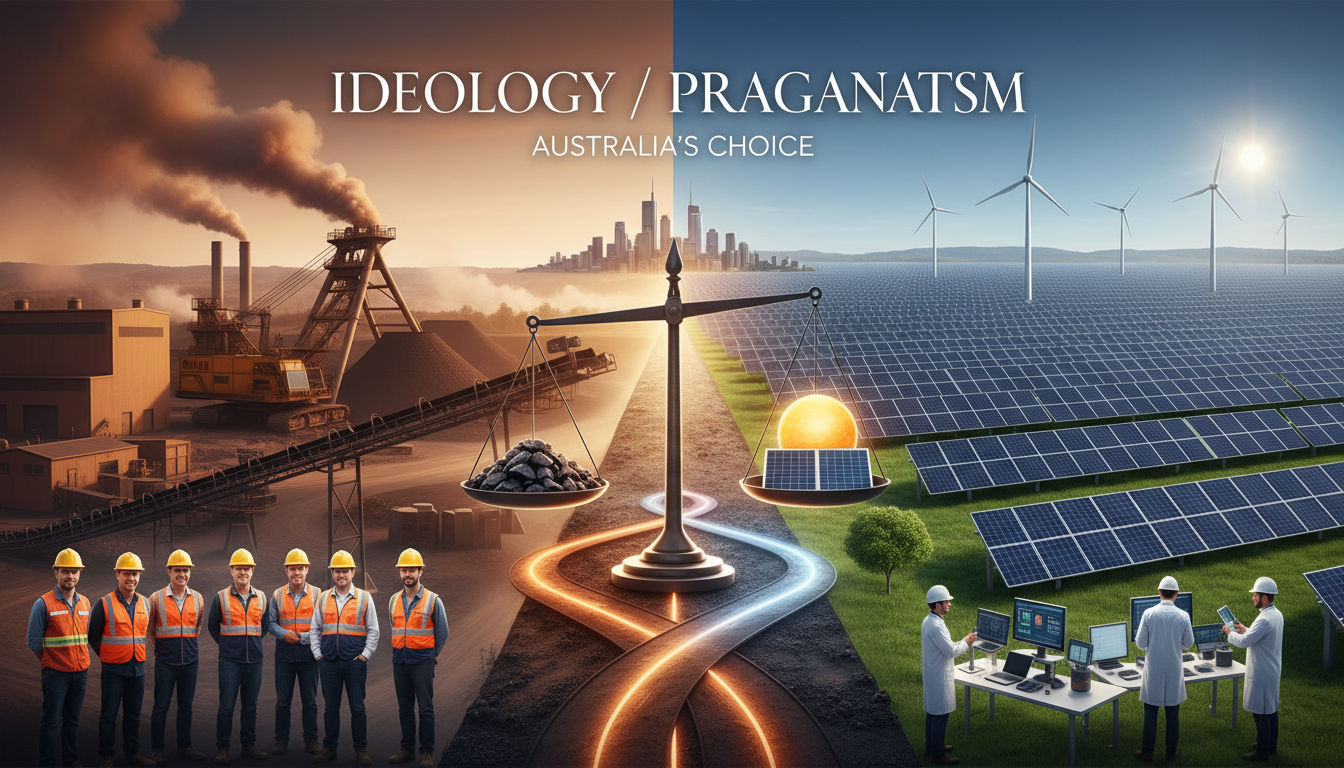
This was a claim made by Lew Kuan Yew more than 4 decades ago. And we need courage to prove him wrong.
Australia Doesn't Have an Energy Problem. It Has a Courage Problem: A case for the Hybrid Energy Strategy — and why the AI revolution makes it urgent.
I've spent considerable time thinking about Australia's energy future, and I keep arriving at the same uncomfortable conclusion: we are one of the most energy-rich nations on Earth, yet we are actively making ourselves energy-poor. Not because we lack resources — but because we lack the political will to use them.
(Of course I used AI to research, find the facts, and type this up - thanks Claude - but the ideas are mine. Here is the link to the FULL POLICY - with facts and figures.)
Here's the situation in three numbers:
1% — Australia's share of global CO₂ emissions. Even if we eliminated every tonne overnight, the impact on global temperatures would be statistically undetectable.
30% — Our share of the world's uranium reserves. The largest deposits on the planet sit under Australian soil. We mine it, we export it to 30 countries — and then we ban ourselves from using it. We are the only G20 nation that does this.
120–176 GW — The projected power demand from global data centres by 2030–2035, driven almost entirely by AI. That's a three-to-fivefold increase from today. Google, Microsoft, Amazon and Meta are already signing billion-dollar nuclear power deals to feed it.
These three facts point to a single conclusion: Australia needs a Hybrid Energy Strategy — one that uses all of our energy assets, not just the ones that are fashionable.
What does "hybrid" actually mean?
It means rejecting the false binary. It means refusing to choose between economic ruin and environmental responsibility when you can have neither.
Concretely, it means five things:
Keep the lights on today. Australia's existing coal fleet is 18 GW of built, connected, dispatchable capacity. You don't shut that down before the replacement is operational. You extend its life, you modernise it, and you build 5–10 GW of new high-efficiency gas to bridge the gap. No ideology — just engineering.
Build a nuclear industry. Small Modular Reactors (SMRs) are purpose-built for a country like Australia: compact footprint, factory-fabricated, passive safety systems, 24/7 baseload output, near-zero operational emissions. Deploy them at decommissioned coal sites where the transmission grid already exists. Target: first reactors online by 2035, 10–20 GW by 2040.
Let renewables compete on merit. I'm not anti-solar — over 4.2 million Australian homes have rooftop panels, and that's great. But grid-scale wind and solar should compete without mandates and without subsidies. And we need to be honest about the full system cost: when you add firming, storage, transmission and curtailment, "cheap" renewables cost $100–150/MWh. That's not cheaper than coal ($40–60), gas ($70–120) or projected SMRs ($64–77).
Capture the AI data centre opportunity. This is the big one. AI workloads need continuous, high-density, baseload power — exactly what intermittent sources cannot provide. Australia has the land, the geological stability, the allied security credentials (AUKUS, Five Eyes), and the uranium. What we need are designated AI Energy Zones, streamlined approvals, nuclear-powered data campuses, and a strategy to position ourselves as the Indo-Pacific's computing hub.
Protect regional communities. The Hunter Valley, Latrobe Valley, Central Queensland, Collie — these communities powered Australia for a century. They don't deserve to be abandoned because inner-city policy preferences changed. A nuclear transition gives these workers a direct pathway to high-skilled, well-paid jobs in the same locations.
The proportionality argument
This is the part that makes people uncomfortable, so let me be direct.
Australia contributes roughly 1% of global CO₂ emissions. China contributes 32%. India 8%. The United States 13%. Even the most aggressive Australian decarbonisation programme would not register as a rounding error on the global ledger.
That doesn't mean we should do nothing. It means we should do things that are proportionate — things that improve our economy, our energy security and our strategic position while also reducing emissions where it's economically rational. A hybrid strategy with nuclear does exactly that.
And here's the kicker: Australian uranium exported to displace coal-fired generation in India and China would reduce global emissions by orders of magnitude more than shutting down every coal plant in Australia. Our greatest climate contribution isn't self-sacrifice — it's being a reliable supplier of clean energy fuel to the world.
The AI imperative makes this urgent
Global uranium demand is projected to increase 117% by 2040. Spot prices are above US$85/lb and rising. Tech giants have signed contracts for more than 10 GW of new nuclear capacity in the past year alone. The US government has issued executive orders to quadruple nuclear output by 2050.
This train is leaving the station. Australia can either be on it — as a fuel supplier, an energy exporter, a data centre host, and a nuclear technology partner — or we can watch from the platform while less stable, less democratic nations fill the vacuum.
The bottom line
Australia doesn't need to choose between coal and solar, between jobs and emissions, between prosperity and responsibility. We need to choose between ideology and pragmatism.
The Hybrid Energy Strategy chooses pragmatism. It keeps the power on today, builds the nuclear backbone of tomorrow, lets renewables earn their place, captures a once-in-a-generation AI opportunity, and positions Australia as a global energy superpower.
That's not a radical idea. It's what every other serious country is already doing.
The only radical thing is that we're not doing it yet.